
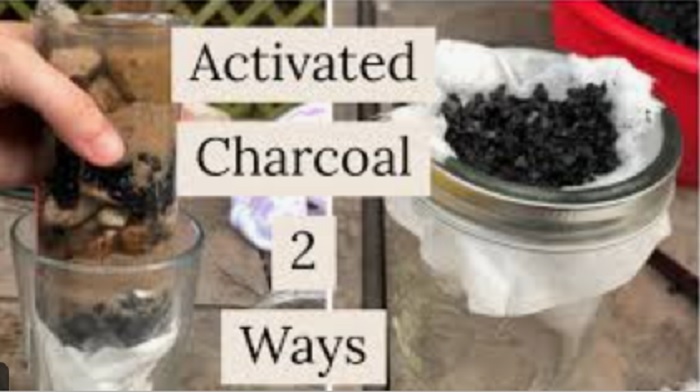
Charcoal turns up in almost every water filter sold, from a jug in a kitchen to a squeeze filter on a thru-hike, and it is one of the most misunderstood components in the whole category. People assume it is doing the disinfecting. It is not, and understanding what it actually does changes how you think about every filter you own.
Charcoal in water purification works by adsorption, not filtration. Activated carbon is processed to create an enormous internal surface area, often several hundred square metres per gram, and organic molecules stick to that surface as water passes through. This removes chlorine, many pesticides and industrial organic compounds, and most of the compounds that cause bad taste and odour. What it does not do is kill or reliably remove bacteria, viruses or protozoa, which is why carbon is always one stage in a treatment system rather than the whole of it.
In short: charcoal grabs dissolved chemicals and improves taste. It is not a disinfectant and never has been.
The EPA treats activated carbon as a recognised treatment stage for organic contaminants and taste and odour compounds rather than as a microbial barrier, and the CDC is clear that backcountry water needs a method that actually addresses pathogens. Those two statements together explain why carbon appears alongside a membrane or a chemical step in every credible product.
Below: how adsorption differs from filtering, what activated carbon is and how it is made, what it removes and what passes straight through, where it fits in a multi-stage system, and when it stops working.
Key Takeaways
- Charcoal works by adsorption, where molecules stick to a surface, not by straining particles out.
- Activated carbon has an enormous internal surface area, often several hundred square metres per gram.
- It removes chlorine, many organic chemicals and most taste and odour compounds.
- It does not reliably remove bacteria, viruses or protozoa, and it does not disinfect anything.
- Carbon is always one stage in a system, usually paired with a membrane or chemical treatment.
- It has a finite capacity. Once the surface is saturated it stops working and must be replaced.
- Campfire charcoal is not activated carbon and should not be used to treat drinking water.
Filters That Use Carbon, and the Stages Around It
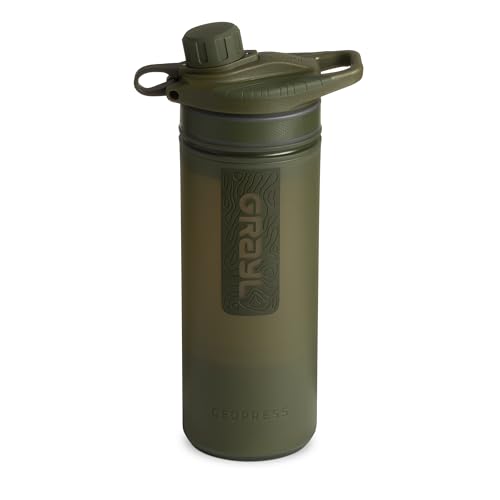
The products below show how carbon sits alongside other treatment stages in practice, from single-stage hollow fibre filters through to multi-stage gravity systems that include a carbon element.
Look at the stage list rather than the headline claim when comparing. What removes pathogens and what improves taste are usually two different components inside the same housing.



Adsorption Is Not Filtration
The distinction sounds pedantic and is actually the whole point. Filtration is physical straining: water passes through pores, and anything larger than the pore is held back. Adsorption is chemical attraction: molecules dissolved in the water stick to a surface they pass over.
Dissolved chlorine cannot be strained out of water, because it is not a particle sitting in the liquid. It is dissolved at the molecular level. Carbon removes it because chlorine molecules are attracted to and bond with the carbon surface, which is a completely different mechanism from the one a hollow fibre membrane uses.
That is why the two technologies appear together so often. A membrane deals with things big enough to strain, such as bacteria and protozoan cysts. Carbon deals with things dissolved at molecular scale, such as chlorine, solvents and the compounds that make water taste of pond.
What Activated Carbon Actually Is
Activated carbon starts as an ordinary carbon-rich material, typically coconut shell, hardwood or coal. It is heated in the absence of oxygen to drive off everything volatile, leaving a carbon skeleton. Then it is activated, usually with steam at high temperature or with chemical treatment, which blows open an enormous network of pores through that skeleton.
The result is a material with a staggering amount of internal surface. A single gram of good activated carbon can present several hundred square metres of surface area, almost all of it inside microscopic pores rather than on the outside of the granule. That surface is what does the adsorbing.
Form matters too. Granular activated carbon is loose granules that water flows between, which is cheap and fast but allows some water to channel past without much contact. A carbon block is compressed into a solid matrix, which forces water through the material and gives better contact at the cost of flow rate.
| Form | How water meets it | Strength | Weakness |
|---|---|---|---|
| Granular activated carbon | Flows between loose granules | Cheap, high flow rate | Water can channel past with little contact |
| Carbon block | Forced through a compressed matrix | Consistent contact, some particle capture | Slower flow, clogs faster with sediment |
| Carbon-impregnated fibre | Passes through a treated medium | Compact, suits small field filters | Lower total capacity than a block |
What It Removes and What Goes Straight Through
Carbon is excellent at a specific class of contaminant: organic molecules, meaning carbon-based compounds. That covers chlorine and chloramines, many pesticides and herbicides, industrial solvents, fuel residues and the broad category of compounds responsible for unpleasant taste and smell.
It is poor or useless at several things people assume it handles. Dissolved minerals and salts pass through unaffected. Most heavy metals are poorly adsorbed by standard carbon unless the medium has been specifically treated for them. Nitrates from agricultural runoff are not removed. And microorganisms are not killed.
| Contaminant | Removed by carbon? | What actually handles it |
|---|---|---|
| Chlorine and chloramines | Yes, very effectively | Carbon is the standard method |
| Taste and odour compounds | Yes | Carbon, which is why water tastes better after |
| Pesticides and solvents | Largely yes | Carbon, depending on the specific compound |
| Bacteria and protozoa | No, not reliably | A membrane filter, or chemical disinfection |
| Viruses | No | Chemical treatment, or a purifier-grade system |
| Dissolved minerals and salts | No | Reverse osmosis or distillation |
| Nitrates | No | Ion exchange or reverse osmosis |
| Most heavy metals | Poorly, unless specially treated | Specific media or reverse osmosis |
| Sediment and turbidity | Partly, in a block form | A dedicated sediment pre-filter |
Where Carbon Fits in a Treatment System
In almost every well-designed system, carbon sits in the middle of a sequence. Sediment is removed first, because particles would otherwise coat the carbon and block access to its pores. Then carbon handles dissolved organics. Then a membrane or a chemical step deals with pathogens.
That order is not arbitrary. Putting carbon before the pathogen stage means the carbon improves taste without being the last line of defence, and any bacteria that colonise the damp carbon are dealt with downstream. Systems that place carbon last rely on the earlier stages having already removed everything biological.
In municipal treatment, carbon is often used after disinfection to remove taste, odour and residual disinfection byproducts. In backcountry gear, it is usually combined with a hollow fibre membrane in the same cartridge, so one squeeze does both jobs.
The pathogen side of the equation is covered separately in how chlorination works in water treatment and what is actually in a water purification tablet.
Capacity, Exhaustion and Replacement
This is the practical failure mode that catches people out. Carbon has a finite number of adsorption sites. Each molecule that sticks occupies one. When they are all occupied, the carbon stops removing anything, and it gives you no indication whatsoever that this has happened.
An exhausted cartridge looks identical to a new one. Water still flows through at the same rate. The only signs are indirect: taste returning, or the manufacturer volume or time limit being exceeded. This is why replacement intervals are specified by volume treated rather than by appearance.
Worse, a saturated carbon bed can release previously captured compounds back into the water under certain conditions, a process known as dumping. That is an unusual event rather than a routine one, but it is another reason not to run a cartridge well past its rated life.
- Check what else is in the system. Find out whether your filter has a membrane or chemical stage as well. Carbon alone is not a microbial barrier, so if there is nothing else, it is not a purifier.
- Flush a new cartridge. Run water through a fresh carbon element and discard the first volume. New carbon sheds fine black dust that is harmless but unpleasant.
- Pre-filter sediment. Remove visible particles before the carbon stage. Sediment coats the carbon surface and blocks access to the pores that do the adsorbing.
- Let the water dwell. Adsorption needs contact time. Forcing water through quickly reduces how much is removed, which is why gravity systems often outperform fast squeeze filters on taste.
- Track usage, not appearance. Carbon looks identical when exhausted. Note the volume treated or the date installed, because there is no visual cue that capacity has run out.
- Replace on schedule. Change the element at the manufacturer interval. A saturated cartridge stops adsorbing and can release previously captured compounds back into the water.
- Dry it between trips. Store carbon elements dry where possible. A damp cartridge left for weeks is a good environment for bacterial growth inside the filter.
Do and Do Not With Carbon Filtration
Do
- Check the full stage list before trusting any filter with a carbon element
- Flush a new cartridge until the water runs clear of black dust
- Remove sediment before the water reaches the carbon
- Slow the flow where you can, since contact time improves adsorption
- Record the installation date or treated volume somewhere you will find it
- Store cartridges dry between trips to limit bacterial growth
Don’t
- Do not treat carbon as a substitute for disinfection
- Do not use campfire or barbecue charcoal on drinking water
- Do not judge remaining capacity by how the cartridge looks
- Do not run a cartridge well past its rated volume or date
- Do not expect carbon to remove minerals, nitrates or most heavy metals
- Do not leave a wet filter sealed in a pack for weeks between trips
If you are deciding what to actually carry, we compare the chemical options in which water purification tablets to carry.
Honest Limits
Performance varies enormously between carbon products, and the generalisations here cannot tell you what a specific cartridge will do. Source material, activation method, pore size distribution, contact time and the particular contaminant all change the outcome, which is why certification to a recognised standard is worth more than a manufacturer adjective.
We have not tested any of these products or verified removal claims. This article explains the mechanism and the general capabilities of activated carbon as a treatment stage; it is not an assessment of how well any particular filter performs against any particular contaminant.
There is also a limit to what any home or field treatment can establish. Without knowing what is actually in your water, you are selecting treatment against assumed contaminants. For a known or suspected chemical problem, laboratory testing of the source is the step that no filter choice can replace.
Stay Safe Out There
The single most important takeaway for outdoor use is that carbon is not a pathogen barrier. If your backcountry water plan relies on a filter whose only active element is carbon, it is not a plan. Pair it with a membrane rated for bacteria and protozoa, or with chemical treatment, or both.
Choose your source as carefully as your treatment. Flowing water upstream of trails, campsites and grazing starts you in a far better position than a still pool, and no filter stage compensates for collecting water downstream of a problem you could have walked past.
Symptoms of waterborne illness often appear days or weeks later, which makes the cause easy to miss. Persistent diarrhoea, cramping, nausea or fatigue after a trip is worth raising with a doctor along with the fact that you were drinking from backcountry sources.
The EPA publishes emergency disinfection guidance and the CDC covers drinking water safety. Both are worth reading before relying on any single treatment method for an extended trip.
Disclaimer: this article is general information, not medical or water-quality advice. Filter performance depends on the product, the contaminant and the conditions, and you are responsible for the water you drink. Follow manufacturer instructions, have a suspect source tested, and seek professional medical help for any symptoms that concern you.
Frequently Asked Questions
What is the role of charcoal in water purification?
Activated carbon removes dissolved organic compounds by adsorption, meaning molecules stick to its enormous internal surface area. That covers chlorine, many pesticides and solvents, and most taste and odour compounds. It does not disinfect water.
Does charcoal kill bacteria in water?
No. Carbon is not a disinfectant and does not reliably remove bacteria, viruses or protozoa. Any filter you rely on for backcountry water needs a membrane rated for pathogens or a chemical treatment stage alongside the carbon.
What is the difference between charcoal and activated carbon?
Activated carbon has been processed, usually with high-temperature steam or chemicals, to open up a vast network of internal pores. That processing is what creates the surface area that makes adsorption work. Ordinary charcoal has a tiny fraction of it.
Can I use campfire charcoal to purify water?
No. It is not activated, so it has very little adsorptive surface, and it carries ash and combustion residues. It will not make unsafe water safe, and it may add contaminants rather than removing them.
What does activated carbon remove from water?
Chlorine and chloramines, many pesticides and herbicides, industrial solvents, fuel residues, and the organic compounds behind bad taste and smell. Dissolved minerals, nitrates and most heavy metals pass through largely unaffected.
How does adsorption differ from filtration?
Filtration physically strains out particles too large to pass through a pore. Adsorption attracts dissolved molecules onto a surface, where they stick. Dissolved chlorine cannot be strained out, which is why carbon rather than a membrane handles it.
How long does a carbon filter last?
It depends on water quality and the cartridge, and it is rated by volume treated or by time rather than by appearance. An exhausted cartridge looks exactly like a new one, so track usage and replace at the manufacturer interval.
Why does new carbon filter water run black?
Fine carbon dust from manufacturing. It is harmless but unpleasant, and flushing a volume of water through a new cartridge and discarding it clears the dust before you start drinking from it.
Does carbon remove heavy metals like lead?
Standard activated carbon removes most heavy metals poorly. Some products use carbon that has been specially treated for lead reduction, and those are certified separately. Check the certification rather than assuming carbon handles it.
Should I choose granular carbon or a carbon block?
A carbon block forces water through the material and generally gives better contact and more consistent performance, at a lower flow rate. Granular carbon is cheaper and faster but allows some water to channel past with limited contact.
The Bottom Line
Charcoal has one job in water purification and does it very well: adsorbing dissolved organic molecules onto an enormous internal surface, which strips out chlorine, many chemical contaminants and nearly everything that makes water taste bad. That is why it appears in almost every filter sold, and why water tastes noticeably better after passing through it.
What it does not do is the part that matters most outdoors. Carbon does not kill or reliably remove bacteria, viruses or protozoa, so it is a stage in a system rather than a system in itself. Check what else is in the housing before you trust a filter in the backcountry, remove sediment before the carbon so the pores stay accessible, and replace the cartridge on schedule, because an exhausted one looks exactly like a new one right up until it is doing nothing at all.