
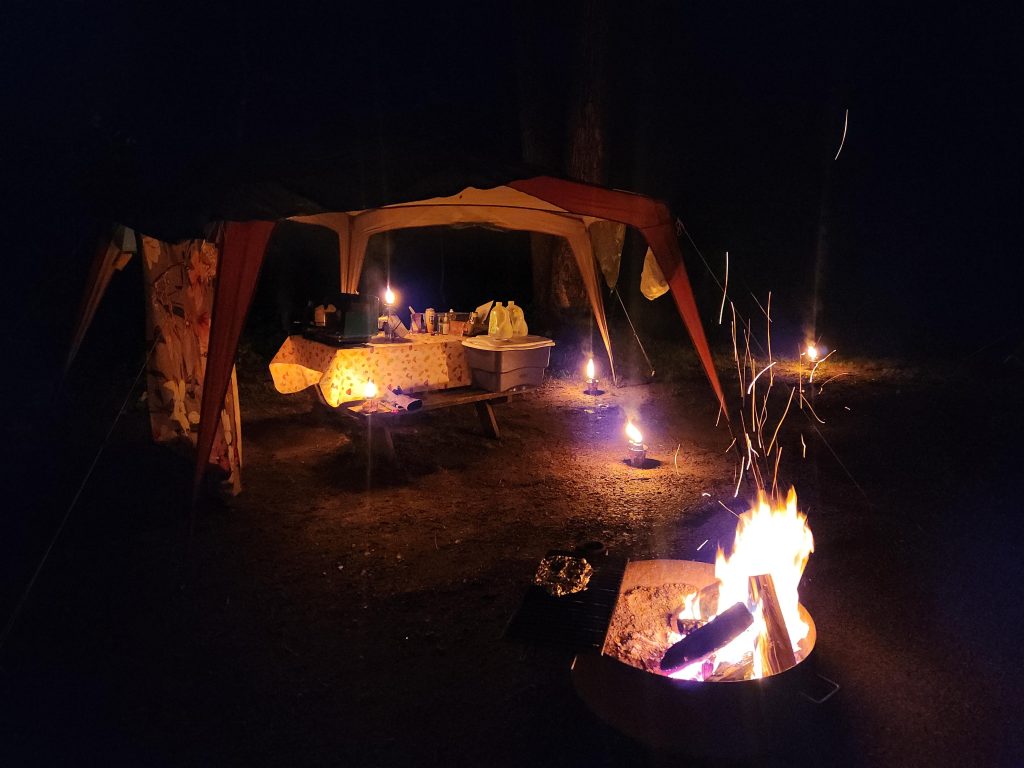
Walk through any busy campground after dark and you will see two kinds of pitch. Some are lit up like a patio, with string lights along the guy lines and a lantern burning in the vestibule. Others are completely dark until someone clicks on a headlamp. Both groups think the other is doing it wrong, and the honest answer is that lighting a tent solves real problems and creates a few of its own.
Most experienced car campers do put some light on or near the tent, but far less of it than beginners expect. A small amount of low, warm light marks guy lines so nobody trips over them, makes your pitch findable when you walk back from the toilet block, and makes the site pleasant to sit at. What it should not do is flood the area, because bright white light destroys your night vision, spills into neighbouring tents, attracts insects and disturbs wildlife. The practical approach is low-level warm light outside, a dimmable lantern inside, and a headlamp with a red mode for everything else.
In short: yes, a little, low and warm. Floodlighting your pitch helps nobody, including you.
There is an etiquette dimension that carries real weight at a developed campground. Quiet hours are standard, and the lighting equivalent matters just as much: a bright lantern left on all night shines straight through nylon walls into whoever is pitched next to you.
Below: what tent lighting is actually for, why bright white light works against you, where to place lights so they help, power options for car camping, and the wildlife and etiquette considerations that decide how much is too much.
Key Takeaways
- A little light is genuinely useful: marking guy lines prevents the most common campsite trip hazard.
- Bright white light destroys night vision, which takes twenty to thirty minutes to recover fully.
- Warm or red light preserves night vision far better than cool white.
- Tent fabric is translucent, so an interior lantern lights up your pitch for everyone around you.
- Insects are drawn to short-wavelength light, so cool white attracts far more than warm.
- Car camping removes the weight limit, so rechargeable lanterns and string lights are practical.
- Never use a fuel-burning lantern inside a closed tent, regardless of how cold it is.
Lighting That Works at a Campsite
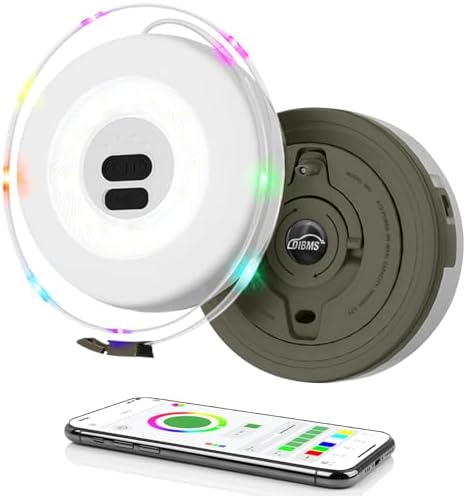
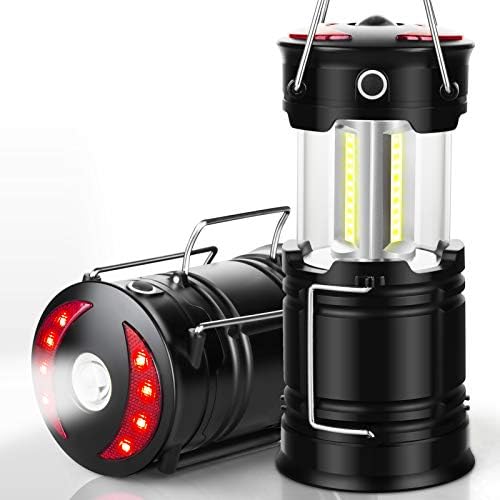
Car camping removes the weight constraint that governs backpacking lighting, which opens up lanterns and string lights that would never make sense in a pack. The items below cover the three layers worth having: ambient, task and personal.
Look for a dimmable or multi-mode option wherever possible. The ability to turn light down is more useful at a campsite than the maximum brightness figure on the box.



What Tent Lighting Is Actually For
There are three distinct jobs, and conflating them is why people end up with either too much light or the wrong kind. Ambient light makes the pitch navigable and pleasant. Task light lets you cook, read or find something in a bag. Personal light moves with you, which means a headlamp.
Guy lines deserve special mention because they are the single most common cause of campsite injuries. A taut cord at shin height, invisible in the dark, catches people walking back from the toilet block. Marking them with a low string light or reflective sleeving is the highest-value lighting decision you can make.
Finding your own tent is the second genuine use. In a large campground where every tent looks similar in the dark, a small distinctive light at your pitch saves the slightly embarrassing experience of unzipping a stranger door. A single low light does this; a floodlit pitch is overkill.
Why Bright White Light Works Against You
Human night vision depends on rod cells in the retina, which take twenty to thirty minutes to reach full dark adaptation and are disrupted by bright light almost instantly. That is the mechanism behind a familiar experience: step away from a bright lantern and you cannot see anything at all for a while.
Red light is the traditional answer because rod cells are least sensitive to long wavelengths, so red light lets you see what you are doing while preserving most of your adaptation. Warm white is a reasonable compromise, and cool white or blue-rich light is the worst for this.
The same wavelength question governs insects. Many flying insects navigate using short-wavelength light, which is why a cool white lantern collects a cloud of them and a warm amber one collects noticeably fewer. If you want to sit outside in summer, warm light is the practical choice rather than an aesthetic one.
| Light type | Night vision | Insect attraction | Best used for |
|---|---|---|---|
| Red | Preserves it well | Very low | Moving around, reading in the tent, night trips |
| Warm white or amber | Moderate disruption | Lower than cool white | Ambient pitch lighting and sitting outside |
| Neutral white | Significant disruption | Moderate | Cooking and tasks that need colour accuracy |
| Cool white or blue-rich | Destroys it quickly | High | Avoid at a campsite; keep for emergencies |
| Colour-changing modes | Varies | Varies | Mostly novelty, though red modes are useful |
Placement Matters More Than Brightness
Tent fabric is translucent, which is the fact that governs everything about interior lighting. A lantern hanging inside your tent does not light your tent, it lights a glowing nylon box visible from across the campground. That is fine at nine in the evening and antisocial at one in the morning.
Pointing light downward is the single most effective adjustment. Light aimed at the ground illuminates where you walk and where you work, while light aimed outward or upward spills into neighbouring pitches and contributes to the glow that washes out the stars you came to see.
Layering is how experienced campers handle it. One dim light inside the tent for finding things, one brighter task light over the cooking area, a low string along the guy lines, and a headlamp on everyone. Nothing is bright, everything is where it is needed, and the pitch next door is unaffected.
- Mark the guy lines first. Run a low string light along the guy lines or clip reflectors to them. This is the one piece of lighting that prevents an actual injury rather than just adding atmosphere.
- Hang one dimmable lantern inside. Clip a lantern to the tent ceiling loop and run it low. One dim light inside a tent is plenty, because the fabric reflects it around.
- Put task light where you cook. Cooking is the job that genuinely needs brightness. Light the cooking area properly and leave the rest of the pitch dim.
- Angle everything downward. Point lights at the ground rather than outward. Light that escapes sideways goes straight into your neighbours and does nothing useful for you.
- Switch to red for moving around. Use the red mode on a headlamp for night trips to the toilet block. It preserves your night vision and does not blind anyone you meet.
- Turn the outside lights off at quiet hours. Leave only what you need to find the tent. Leaving string lights on all night is the lighting equivalent of playing music at 2 a.m.
- Charge everything during the day. Solar lights need daylight exposure, and rechargeable lanterns top up from the car. Plan the charging rather than discovering flat batteries at dusk.
Power Options When You Have a Car
Car camping removes the constraint that shapes backpacking lighting entirely. Weight stops mattering, which means rechargeable lanterns with substantial batteries, string lights that run all evening, and the ability to recharge everything from the vehicle become practical choices rather than luxuries.
Rechargeable USB lights are the default now and suit car camping well, because the car is a charging point. Solar string lights work without any charging effort at all, provided you remember to leave them in sun during the day rather than packed in a bag.
Replaceable batteries still have a place as backup, since they work when a power bank is flat and do not care about charge cycles. A headlamp that takes AAA batteries plus a spare set is a reliable fallback for the one light you genuinely cannot do without.
| Power source | Best for | Watch out for |
|---|---|---|
| USB rechargeable | Lanterns and headlamps when you have a car | Arriving with everything flat; charge before you leave |
| Solar | String lights and ambient lighting | Needs daylight exposure, so unpack them in the morning |
| Replaceable batteries | A backup light you cannot afford to lose | Carry spares; performance drops in cold |
| Car 12V socket | Topping up power banks and lanterns | Do not flatten the starter battery while parked |
| Power bank | Recharging headlamps away from the car | Capacity drops in cold; keep it in your sleeping bag |
Wildlife, Neighbours and Where the Line Is
Artificial light at night affects wildlife behaviour, which is a general concern everywhere and a specific regulated one in some places. Coastal sites during sea turtle nesting season commonly restrict lighting, because hatchlings orient toward the brightest horizon and inland lights draw them away from the sea.
More broadly, lighting a pitch brightly removes much of what people come for. Dark-sky visibility at a good campground is genuinely remarkable, and a single bright lantern within a hundred feet is enough to wash it out for everyone nearby.
Do
- Mark guy lines with low light or reflective sleeving
- Use warm or red light for anything other than cooking
- Angle lights downward so the spill lands on your own pitch
- Keep one dim light inside the tent rather than a bright one
- Turn outdoor lights off at quiet hours
- Check for lighting restrictions at coastal and dark-sky sites
Don’t
- Do not floodlight your pitch; it blinds you as much as anyone else
- Do not leave string lights burning all night
- Do not point lights toward neighbouring tents or footpaths
- Do not use cool white light if you want to sit outside in summer
- Do not rely on a phone torch as your only light source
- Do not use a fuel-burning lantern inside a closed tent
Lighting is one line on a longer list: see what to pack for tent camping. If you are choosing a tent, hanging loops and interior pockets matter more than the brochure suggests, which we cover in family camping tents worth considering.
What the Minimalists Get Right
There is a reasonable case for carrying one headlamp and nothing else, and it is worth taking seriously. A headlamp covers every genuine need: you can cook by it, find things by it, walk by it, and it points wherever you are looking. Everything beyond that is comfort and atmosphere.
The counterargument is that car camping is largely about comfort and atmosphere, and that a lit pitch is a pleasant place to sit for an evening in a way a dark one is not. Both positions are defensible, and the split usually tracks whether someone camps to be outdoors or camps to go somewhere.
The middle ground most people land on is one headlamp each, one dimmable lantern, and a low string along the guy lines. That covers safety, task and atmosphere with three items, which is considerably less than the lighting setups on display at any busy campground on a summer weekend.
For the broader comfort question, our comparison of how tent camping compares with an RV covers the same tension from a different angle.
Honest Limits
How much lighting is appropriate depends heavily on where you are. A busy family campground with a toilet block and footpaths is a different proposition from a quiet dispersed site, and what reads as sensible at one looks excessive at the other.
Individual tolerance for light at night also varies considerably, both in terms of what disturbs sleep and in terms of how quickly night vision recovers. The twenty to thirty minute figure for dark adaptation is a general one, and age and individual physiology both affect it.
The products here are selected from listing specifications and from what buyers widely report rather than controlled comparison. Brightness figures in particular are published inconsistently across this category, and a stated lumen figure is not a reliable way to compare two lanterns from different brands.
Stay Safe Out There
The genuine safety benefit of campsite lighting is tripping hazards, and guy lines are the main one. Mark them, and keep the route between your tent and wherever you walk at night clear of pegs, cords and gear left out after dark.
Always have a personal light that works. A headlamp with charged batteries, plus a backup or spare set, covers the situation where you need to deal with something at three in the morning. A phone torch is a last resort rather than a plan, because you may need that battery for something else.
Campground rules on quiet hours and lighting vary by site, and some areas have seasonal restrictions. The National Park Service publishes guidance updated as conditions change, and checking before you arrive avoids running into a local rule you did not know existed.
Disclaimer: this article is general outdoor information, not safety advice. Conditions, equipment and local rules vary, and you are responsible for decisions made on your trip. Check local rules, follow manufacturer instructions for any lighting or fuel equipment, and seek professional medical help for any injury that concerns you.
Frequently Asked Questions
Do you put lights on your tent when car camping?
Most people do, but less than beginners expect. A low string light along the guy lines and one dimmable lantern inside covers safety and comfort. Floodlighting a pitch ruins your night vision and spills into neighbouring tents.
What kind of light is best for a tent?
A dimmable rechargeable lantern with a warm or red mode, hung from the tent ceiling loop. Tent fabric reflects light around, so one dim light inside is enough, and the ability to turn it down matters more than peak brightness.
Why does red light get recommended?
Because the rod cells responsible for night vision are least sensitive to long wavelengths. Red light lets you see what you are doing while preserving most of your dark adaptation, which otherwise takes twenty to thirty minutes to rebuild.
Do lights attract insects to the tent?
Short-wavelength light does, which is why a cool white lantern collects a cloud of insects and a warm amber one collects far fewer. If you want to sit outside on a summer evening, warm light is the practical choice.
Should I leave lights on all night?
No. Leave only what you need to find the tent, and turn the rest off at quiet hours. Tent fabric is translucent, so a lantern burning inside shines straight through into whoever is pitched beside you.
Can I use a gas lantern inside my tent?
No. Burning fuel consumes oxygen and produces carbon monoxide, which is odorless and builds quickly in an enclosed space. Battery or rechargeable lights are the only safe option inside a tent, in any weather.
Are string lights worth it?
For car camping, yes, mainly because running them along guy lines prevents the most common campsite injury. As atmosphere they are optional, but as a marker for taut cords at shin height they earn their place.
Solar, rechargeable or batteries?
Rechargeable suits car camping because the vehicle is a charging point. Solar works well for string lights if you remember to leave them in the sun. Keep one battery-powered light as backup, since it works regardless of charge state.
How many lights do I actually need?
Three types rather than three dozen items: a headlamp each, one dimmable lantern, and a low string along the guy lines. That covers personal, task and ambient lighting, which is everything a campsite genuinely requires.
Do campsite lights disturb wildlife?
Yes, and in some places it is regulated. Coastal sites during sea turtle nesting season often restrict lighting, because hatchlings orient toward the brightest horizon. More generally, bright pitches wash out the dark sky for everyone nearby.
The Bottom Line
Yes, put some light on your tent, and considerably less than the setups you see at busy campgrounds. The genuinely useful job is marking guy lines so nobody walks into a cord at shin height, followed by making your pitch findable and pleasant to sit at. A low string light and one dimmable lantern does all of that.
What works against you is brightness and colour. Cool white light destroys night vision that takes half an hour to rebuild, collects every insect in the area, and shines straight through tent fabric into whoever is next to you. Go warm or red, angle everything downward, turn the outside lights off at quiet hours, and keep a headlamp on everyone for the rest.