
A family tent is the one piece of gear that decides whether a wet weekend is a happy memory or the reason nobody wants to go again. Capacity ratings are optimistic, headroom is quoted at the single highest point, and setup times assume you have done it before. This guide covers 10 options, from two-minute instant cabins to screened tunnel tents, and explains what the numbers actually mean.
The best family camping tent for most people is a straight-wall cabin rated for two to four more people than will sleep in it, with a fully taped rainfly, sealed seams and a center height over 72 inches. Capacity numbers describe bodies on the floor with no gear, so a six person tent realistically sleeps four people plus their kit. Straight walls matter more than floor area, because dome walls curve inward exactly where you want to stand up and get dressed, and a fully taped fly with sealed floor seams predicts real dryness far better than any waterproof rating on the box.
In short: size up by at least two places, prioritize standing room over square footage, and check that the fly is taped and the seams are sealed.
The National Park Service advises keeping tents and anything else flammable at least 15 feet from a fire pit and upwind of it, which is worth remembering when you pick a pitch. A large family tent needs a bigger clear footprint than people expect, and crowding it toward the fire ring to fit is a common and avoidable mistake.
Below you will find how we chose these tents, the 10 picks in price order with honest limits on each, and a buying guide covering capacity, weather protection, setup systems, ventilation and the care that keeps a tent waterproof for more than one season.
We may earn a commission from qualifying purchases made through links on this page, at no extra cost to you. Full disclosure.
Top 3 Picks at a Glance
Key Takeaways
- Best Overall is the CORE Family Camping Straight Wall Cabin Tent: near-vertical walls and an 86 inch center height give genuine standing room across the floor.
- Best Instant Setup is the CORE 9 Person Instant Cabin Tent, with pre-attached poles that lock out in around two minutes.
- Best for Large Groups is the FanttikOutdoor Instant Camping Tent, the largest floor area here at 168 by 120 inches.
- Treat every capacity rating as bodies on the floor with no gear. Size up by two places at minimum.
- Straight walls beat extra floor area, because dome walls take away space exactly where you stand.
- A taped rainfly and sealed seams matter more than any waterproof rating printed on the box.
- Condensation is not a leak. Most water inside a family tent comes from breath and wet kit, and ventilation is the fix.
How We Chose These Products
These are research-based picks rather than field tests. We shortlisted from current Amazon listings carrying strong ratings from a large number of shoppers, favoring established camping brands and fuller-featured models where the price difference was small. Listings with thin review histories were excluded unless they covered a use case nothing else did.
Specifications were checked against what matters for family camping: actual floor dimensions rather than person ratings, center height, wall geometry, whether the rainfly is fully taped and the seams sealed, ventilation design, pole material and the realistic setup time quoted by the maker. Claims we could not confirm from the listing itself were left out.
We capped the list at two products per brand, excluded near-duplicates such as the same tent in a different capacity, and left out sponsored placements. Both instant and conventional pole systems are represented, because the right answer genuinely depends on whether you move campsite often or settle in one place.
The 10 Best Family Camping Tents Right Now
The list runs from the highest priced tent down to the lowest. Badges describe what each tent is genuinely best at rather than ranking them on one scale, because a blackout cabin for toddlers and a wind-shedding tunnel tent are not competing for the same job.
| # | Product | Best for | Standout feature | |
|---|---|---|---|---|
| 1 | CORE Family Camping Straight Wall Cabin Tent | big groups who want genuine standing room | Near-vertical walls with an 86 inch center height | View |
| 2 | CORE 9 Person Instant Cabin Tent | arriving late and wanting shelter up fast | Pre-attached poles that lock out in about two minutes | View |
| 3 | FanttikOutdoor Instant Camping Tent | the largest sleeping capacity on this list | 168 by 120 inch floor with a sub-60-second pitch | View |
| 4 | EVER ADVANCED Blackout Instant Cabin Tent | families with young children or late sleepers | Blackout fabric that holds back early summer light | View |
| 5 | TIMBER RIDGE 8 Person Family Tent with Screen Porch | bug-heavy sites where you want to sit outside | Screened porch that keeps insects out of living space | View |
| 6 | Coleman Sundome Camping Tent with Rainfly | wet-climate camping on a sensible budget | Welded corners and inverted seams at the floor | View |
| 7 | PORTAL Family Tunnel Tent with Screen Porch | windy sites where a tall cabin would catch the gusts | Tunnel profile with a 4 by 8 foot screen room | View |
| 8 | CAMPROS CP 8 Person Camping Tent with Room Divider | mixed groups who need two separate spaces | Straight walls with a divider that doubles as a screen | View |
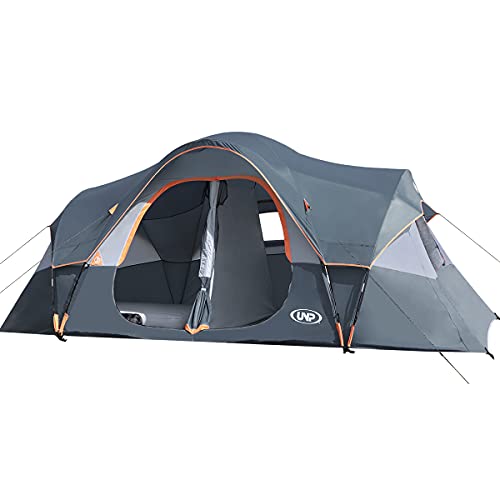
| 9 | UNP Portable Cabin Camping Tent | getting cabin space without cabin money | 1000mm coated fabric with steel leg poles | View |
| 10 | Amazon Basics 3-Season Dome Tent with Rainfly | occasional trips and first-time campers | Freestanding dome that pitches in under six minutes | View |
CORE Family Camping Straight Wall Cabin Tent

Best for: big groups who want genuine standing room
The straight wall design is what separates this from every dome on the list. The listing gives a 16 by 11 foot footprint with an 86 inch center height, enough that adults stand upright across most of the floor rather than only at the peak. For families who spend rainy mornings inside, that single dimension changes the experience more than any other feature.
Dome tents of similar floor area feel far smaller because the walls curve inward exactly where you want to stand. Against the instant tents further down the list, you trade a couple of minutes of setup for substantially more usable volume and a room divider. It is the largest and most expensive pick here, and the one that justifies the space.
Key features
- Near straight-wall design for standing room across the floor
- 16 by 11 foot floor with an 86 inch center height
- H20 Block coated fabric with taped rainfly and sealed seams
- Room divider creates two separate sleeping spaces
Pros
- Standing room that domes of the same size cannot match
- Room divider gives privacy for mixed groups
- Taped fly and sealed seams on a large footprint
Cons
- Needs a large, level pitch that not all sites offer
- Heavy and bulky to carry from the car
Skip it if: your usual campsite pitches are small or uneven.
Check Price on AmazonCORE 9 Person Instant Cabin Tent

Best for: arriving late and wanting shelter up fast
Pre-attached poles mean you unfold the tent, extend each leg until it locks, and you are done. The listing claims two minutes or less, and the mechanism is the reason: there are no poles to thread, nothing to lose, and nothing to work out in the dark. For families arriving after sunset with tired children, that is worth real money.
The trade is packed size and weight, because the poles travel with the tent and never come out. Against the straight wall CORE above it, you lose some headroom and the 14 by 9 foot floor is smaller. Against the cheaper instant tents here, the weather protection specification is a step up.
Key features
- Pre-attached poles lock into place for a fast pitch
- 14 by 9 foot floor with a 78 inch center height
- H20 Block coated fabric with taped rainfly and sealed seams
- Lower vents plus a mesh ceiling for airflow
Pros
- Genuinely fast to pitch, even alone
- Good weather specification for an instant tent
- Ventilation works from floor to ceiling
Cons
- Bulky packed size because poles stay attached
- Less headroom than the straight wall design
Skip it if: you drive a small car and pack size matters.
Check Price on AmazonFanttikOutdoor Instant Camping Tent

Best for: the largest sleeping capacity on this list
This is the biggest floor area here, listed at 168 by 120 inches, with pre-attached poles that the maker rates for a sub-60-second pitch. The listing is candid that the ten person figure is sleeping capacity only, which is the honest way to read every tent rating. For six people plus gear it is genuinely roomy.
Compared with the CORE instant tent above, you gain floor area and lose a little in the weather specification detail the listing provides. Compared with the tunnel and cabin tents lower down, the instant pole system is faster but heavier. Mesh on all four sides puts its ventilation ahead of most tents this size.
Key features
- Pre-attached poles for a pitch in under a minute
- 168 by 120 inch floor area
- Mesh windows on all four sides plus floor-level vents
- Waterproof fabric with a protected door zipper
Pros
- Largest floor area of any pick here
- Four-sided mesh keeps a big tent ventilated
- Very fast to pitch for its size
Cons
- Ten person rating is sleeping capacity with no gear space
- Heavy and awkward for one person to carry
Skip it if: you camp as a couple or a small family.
Check Price on AmazonEVER ADVANCED Blackout Instant Cabin Tent

Best for: families with young children or late sleepers
Dark fabric is the feature parents ask about most, because summer sunrise at five in the morning ends everyone’s night. The listing describes a blackout design intended for sleeping in and for privacy, on a cabin tent that one person can pitch in about sixty seconds. For families with toddlers, that combination is the whole argument.
Blackout fabric runs warmer in direct sun than a light-colored tent, which is why the three mesh roll-up windows and the overhead net matter here more than usual. Against the larger picks above, the 9 by 9 foot floor is tighter, but for a family of four with the kit stowed along one wall it works.
Key features
- Blackout fabric designed for sleeping in and privacy
- Pitches in around 60 seconds, manageable by one person
- Three zippered roll-up mesh windows plus an overhead net
- 9 by 9 foot floor with a 73 inch center height
Pros
- Genuinely darker inside than a standard tent
- Fast enough to pitch alone with children in tow
- Good ventilation for a blackout design
Cons
- Dark fabric absorbs heat in direct sun
- Tighter floor than the bigger picks here
Skip it if: you camp mostly in cool weather where heat build-up is never an issue.
Check Price on AmazonTIMBER RIDGE 8 Person Family Tent with Screen Porch

Best for: bug-heavy sites where you want to sit outside
A screen porch solves a problem families hit constantly: you want to sit out in the evening without feeding the local insects, and you want somewhere to leave muddy boots that is not the sleeping area. The listing pairs that porch with 66D fabric and a water-resistant coating on an eight person footprint.
Against the cabin tents above, the porch adds living space without adding sleeping capacity, which is the right trade for most families. Setup is slower, listed at about fifteen minutes for two people with color-coded poles, so this is a tent for staying put for several nights rather than one that suits moving campsite every day.
Key features
- Screened porch section separate from the sleeping area
- 66D fabric with a water-resistant coating
- Upgraded fiberglass poles for flexibility under load
- Full mesh ceiling, windows and doors for cross ventilation
Pros
- Porch genuinely extends usable living space
- Good cross ventilation reduces condensation
- Color-coded poles make the longer pitch straightforward
Cons
- Around fifteen minutes to pitch with two people
- Fiberglass poles are heavier than aluminum
Skip it if: you move campsite every night and want speed.
Check Price on AmazonColeman Sundome Camping Tent with Rainfly

Best for: wet-climate camping on a sensible budget
Coleman’s WeatherTec construction is the specific reason this pick is here. Welded corners and inverted seams attack the place tents actually leak, which is the floor perimeter rather than the fly. On a dome at this price that is unusual, and it is why the Sundome keeps appearing on wet-weather trips year after year.
It is a dome, so you lose the standing room of the cabin tents above and the floor is smaller than the big group picks. What you get instead is a six foot center height, a simple pole system that packs small, and a weather specification that holds up. For two to four people in a wet climate it is the sensible choice.
Key features
- WeatherTec system with welded corners and inverted seams
- Six foot center height with room for two queen airbeds
- Large windows and a ground vent for airflow
- Continuous pole sleeves with clip attachments for fast pitching
Pros
- Floor construction genuinely resists water ingress
- Packs smaller than any cabin tent here
- Simple, proven pole design
Cons
- Dome walls cut usable space at the edges
- No room divider or porch
Skip it if: you want standing room across the whole floor.
Check Price on AmazonPORTAL Family Tunnel Tent with Screen Porch

Best for: windy sites where a tall cabin would catch the gusts
Tunnel tents sit lower and present a shallower face to the wind than a straight wall cabin, which matters on exposed pitches. The listing gives a 15 by 8 foot overall length including a 4 by 8 foot screen porch, with a 76 inch height, so you still get head height without the sail area of a vertical-walled tent.
Against the TIMBER RIDGE porch tent above, the tunnel shape handles wind better but needs to be pitched with the right end into it. Against the cabin tents, you lose some corner space to the curve. Setup is listed at around five minutes for two people, faster than most tents with a porch.
Key features
- Tunnel profile that sheds wind better than vertical walls
- 15 by 8 foot total length including a 4 by 8 foot porch
- 66D fabric with water-resistant coating and removable rainfly
- Mesh ceiling, windows, doors and screened porch
Pros
- Better in wind than any cabin tent here
- Porch included without a long pitch time
- Removable fly lets you open it up in fair weather
Cons
- Must be oriented correctly relative to the wind
- Curved walls lose some corner floor space
Skip it if: you camp in sheltered woodland where wind is never the issue.
Check Price on AmazonCAMPROS CP 8 Person Camping Tent with Room Divider

Best for: mixed groups who need two separate spaces
Straight walls and a 72 inch center height give this more usable volume than its footprint suggests, and the divider curtain splits it into two rooms for adults and children or two couples. The listing notes the curtain also works as a projector screen, which is a small touch that families with teenagers will actually use.
It is a simpler build than the CORE straight wall tent at the top of the list, with a lower ceiling and less detail in the weather specification. Setup is listed at five minutes for two people with color-coded poles, which is quick for a tent of this size without pre-attached poles.
Key features
- Straight wall design with a 72 inch center height
- Divider curtain creates two rooms
- Coated fabric with sealed seams and a waterproof strip
- Mesh top and doors for ventilation
Pros
- Good standing room for the price
- Divider adds real privacy for mixed groups
- Quick to pitch for its size
Cons
- Weather specification is less detailed than premium picks
- Fiberglass poles flex more in gusts
Skip it if: you need the highest weather protection on exposed ground.
Check Price on AmazonUNP Portable Cabin Camping Tent

Best for: getting cabin space without cabin money
The specification here is better than the price suggests: a 1000mm hydrostatic-rated polyurethane coating, steel leg poles rather than all fiberglass, and a 12 foot floor. The listing is honest that eight people is a squeeze and six plus gear is the comfortable number, which matches how families actually use a tent this size.
Against the CAMPROS and PORTAL picks above it, you give up the room divider and the porch but keep most of the space and gain steel legs at the corners. Against the Amazon Basics dome below, it is a far larger and taller tent for a modest step up in price.
Key features
- 1000mm rated polyurethane coated fabric
- Steel leg poles at the corners for stability
- Two mesh doors, six mesh windows and a mesh ceiling
- Pitched by two people in around ten minutes
Pros
- Strong specification for the money
- Steel legs stiffen the structure
- Excellent ventilation for a cabin tent
Cons
- No room divider or porch
- Ten minute pitch is slower than the instant tents
Skip it if: you want a divided interior or a screened porch.
Check Price on AmazonAmazon Basics 3-Season Dome Tent with Rainfly

Best for: occasional trips and first-time campers
A plain, freestanding three-season dome that does the fundamentals: coated polyester with welded seams, a removable rainfly with a cool-air port, and shock-corded poles in snag-free sleeves. The listing puts setup at under six minutes. For a family trying camping for the first time, it removes the risk from the decision.
Everything above it offers more space, more headroom or better weather detail. What this offers is a low entry point and a freestanding design you can pick up and move once pitched, which is genuinely useful when you realise your chosen patch slopes. Treat it as a starting tent rather than a long-term one.
Key features
- Water-resistant coated polyester with welded seams
- Removable rainfly with a back window and cool-air port
- Shock-corded poles in snag-free sleeves
- Freestanding dome that can be lifted and repositioned
Pros
- Low risk way to find out if you enjoy camping
- Freestanding design is easy to reposition
- Simple enough to pitch without instructions
Cons
- Dome walls limit usable space and headroom
- Basic fabric and poles compared with the rest
Skip it if: you already know you camp often and want a tent to grow into.
Check Price on AmazonCapacity Ratings Are Not What You Think
Tent capacity describes how many adult bodies fit side by side on the floor with nothing else in the tent. No gear, no space between sleepers, no room to stand up and dress. It is a packing figure, not a comfort figure, and treating it as the latter is the single most common family camping mistake.
The working rule is to size up by at least two places, and by four if anyone is bringing an airbed. A queen airbed occupies roughly the footprint of two to three rated sleeping places on its own, which is why a six person tent fits two airbeds and nothing else. Manufacturers that quote how many queen beds fit are doing you a favour.
| Rated capacity | Realistic sleepers with gear | Fits airbeds | Suits |
|---|---|---|---|
| 4 person | 2 adults | One queen, no floor space left | A couple with a dog, or two adults packing light |
| 6 person | 3 to 4 | Two queens, nothing else | A family of four with gear stored along one wall |
| 8 person | 5 to 6 | Two queens plus floor space | A family of five, or four with a lot of kit |
| 9 to 10 person | 6 to 7 | Three to four queens | Two families sharing, or one family that likes space |
Center height is quoted at the single tallest point, usually the middle of the roof. In a dome that point is the only place an adult stands upright. In a straight wall cabin the usable height extends nearly to the walls, which is why a cabin with the same floor area and the same quoted height feels dramatically larger inside.
Weather Protection: What Actually Keeps Water Out
Family tents leak in three places and almost never through the middle of the fabric. Water comes in at unsealed seams, through the floor perimeter where the groundsheet meets the wall, and by wicking across any point where the rainfly touches the inner tent. Hydrostatic head numbers on the box address none of these.
A fully taped rainfly means the seams have heat-sealed tape over the stitch line, so the needle holes cannot admit water. Welded or inverted floor seams move the stitching away from ground level, which is what the Coleman WeatherTec construction is doing. Those two details predict real-world dryness far better than a coating rating.
| What you see | Likely cause | What fixes it |
|---|---|---|
| Even damp film on the inner roof in the morning | Condensation from breath and wet kit | Open vents at both high and low points overnight |
| Wet patch directly under where fly touches inner | Fly contact wicking water through | Retension guy lines so the fly stands clear |
| Water tracking in along a stitch line | Unsealed or failed seam tape | Seam sealer on the inside of the stitch line |
| Damp spreading up from the floor edge | Groundsheet perimeter or pooling underneath | Reposition off the low spot, add a footprint |
| Drips from a single point in heavy rain | Pinhole or abrasion through the coating | Repair patch or a coating touch-up |
Instant Poles or Conventional Poles
Instant tents arrive with the poles already threaded and hinged to the body. You unfold the tent, extend each leg until it clicks, and the structure stands. The time saving is real, often two minutes against fifteen, and it matters most in the dark, in rain, or with small children who need supervising.
The cost is packed size and weight, because the poles travel with the fabric and cannot be separated. An instant eight person tent is a genuinely awkward object to carry across a campsite, and it will dominate a car boot. If you pitch once and stay a week, that is irrelevant. If you move every night, it is the deciding factor.
Do
- Choose instant poles if you arrive late, camp with young children, or pitch in bad weather
- Choose conventional poles if boot space is tight or you move campsite frequently
- Practice the pitch once in the garden before the first trip
- Count the pegs and guy lines against the instructions before leaving home
- Carry a few spare pegs, since bent pegs are the most common small failure
Don’t
- Do not force an instant leg that will not lock, since the hinge is usually catching on fabric
- Do not pitch a cabin tent broadside to strong wind
- Do not skip guy lines in fair weather, because weather changes overnight
- Do not store a tent damp, even for a few days
- Do not use a footprint larger than the tent floor, since it channels rain underneath
Ventilation, Blackout Fabric and Sleeping Past Dawn
Four people breathing overnight release a surprising volume of water vapour, and in a sealed tent it condenses on the coldest surface, which is the inside of the fly. That is why a tent can be completely waterproof and still be wet inside by morning. Ventilation is not a comfort feature, it is the mechanism that keeps a family tent dry.
Effective ventilation needs openings at two heights. Low vents near the floor let cool air in, and a mesh ceiling or high vent lets warm moist air escape. Tents with mesh only in the doors move far less air than the specification suggests, because there is no pressure difference driving flow.
Blackout fabric is a genuine advantage for families with young children in summer, when sunrise arrives before five. The trade is heat: dark coatings absorb more solar energy, so a blackout tent in open sun warms faster than a light one. Pick a pitch with afternoon shade and use every window, and the problem largely disappears.
Once the tent is sorted, the rest of the kit list matters: see what to pack for tent camping and our list of must-have tent camping items before your first family trip.
Pitching and Packing Without Shortening Its Life
Family tents rarely die of fabric failure. They die of mildew after being packed wet, of coatings degraded by prolonged UV exposure, and of groundsheets punctured by debris nobody cleared before pitching. All three are avoidable with a routine that takes a few minutes.
- Clear the footprint. Sweep away stones, cones and sticks across the whole floor area. A single sharp stone is the most common cause of a punctured groundsheet.
- Orient for wind and sun. Put the smallest end or the door away from the prevailing wind, and face the door away from the morning sun if you want to sleep past dawn.
- Stake the floor before raising. Peg the corners of the groundsheet first so the floor stays square. A tent pitched out of square never tensions properly afterwards.
- Raise and lock the poles. Work around the tent rather than finishing one side, so the load spreads evenly as the structure comes up.
- Tension the fly separately. The fly should not touch the inner anywhere. Any contact point will transfer water inside and look exactly like a leak.
- Guy out everything. Use every guy point, not just the ones that look necessary. Guy lines keep the fly off the inner and stop poles flexing in gusts.
- Dry it fully before storage. Pitch it again at home if you packed it damp. Mildew destroys coatings permanently and is the main reason family tents fail in year three.
Long-term, keep a tent out of constant direct sun when you are not using it. UV degrades polyester and the polyurethane coatings on the inside of the fly, which is why tents left pitched on a sunny pitch all summer turn sticky and flake. A season of weekends does no harm; three months in full sun does.
Honest Limits
These picks come from listing specifications and from what buyers widely report, not from controlled testing. We have not pitched them side by side, measured their hydrostatic performance, or put them through a season of weather. Where a listing makes a claim we could not verify, we have left it out rather than repeating it.
There are also limits to what any family tent can do. None of these is a mountaineering shelter, and large flat-walled tents in particular are vulnerable in sustained high wind no matter how well they are guyed. If a serious storm is forecast, the right decision is to pack up and go home rather than to trust a tent beyond its design.
Finally, fit to your car and your site matters as much as any specification here. A 16 by 11 foot footprint rules out a lot of pitches, and an instant tent that will not fit in your boot alongside everything else is the wrong tent regardless of how good it is. Measure both before you buy.
Stay Safe Out There
Pick your pitch with the weather in mind rather than the view. Avoid the lowest point of a field where water collects, stay clear of dead branches overhead, and on exposed ground put the tent behind whatever natural shelter exists. Check the forecast before you travel and again on arrival, because conditions change faster than plans do.
Keep fire well away from fabric. Tent materials melt and burn quickly, and sparks carry further than people expect on a breezy evening.
The National Park Service recommends keeping tents, gear and anything flammable at least 15 feet from the fire pit and upwind of it, and warns that gray coals can hold heat for hours: see its campfire safety guidance. Rules and fire restrictions vary by park and season, so check locally before you go.
If someone shows signs of hypothermia, which means shivering they cannot control, clumsiness or confusion, get them out of the wind, into dry layers and insulated from the ground, and seek medical help. Cold ground draws heat faster than cold air, so a sleeping mat matters more than an extra blanket. Planning a trip in genuinely cold conditions is a different exercise, covered in our guide to <a href=”https://solotentlife.com/best-tents-for-winter-camping/”>tents built for winter camping</a>.
Disclaimer: this article is general outdoor information, not safety, medical or legal advice. Conditions change, equipment fails, and you are responsible for decisions made on your trip. Check local rules, ask a ranger when you are unsure, and seek professional medical help for any injury or cold-related symptoms that concern you.
Frequently Asked Questions
What size family tent do I actually need?
Take the number of people sleeping in it and add at least two to the rating, or four if anyone brings an airbed. A six person tent realistically sleeps three or four with their gear, because the rating counts bodies on the floor with nothing else in the tent.
Which tent here is best for a family of four?
The Coleman Sundome if you want something that packs small and handles wet weather, or the EVER ADVANCED blackout cabin if early summer sunrises are waking the children. Both give four people room once gear is stowed along one wall.
Is the most expensive tent on this list worth it?
The CORE straight wall cabin earns its price if you camp often and spend time inside the tent, because standing room across the whole floor genuinely changes wet days. For two or three trips a year, the mid-priced cabins give most of the benefit.
Are instant tents actually faster to pitch?
Yes, substantially. Pre-attached poles turn a fifteen minute job into roughly two minutes. The cost is packed size and weight, since the poles cannot be separated from the fabric, so they dominate a car boot and are awkward to carry.
Why is the inside of my tent wet when it has not rained?
That is condensation, not a leak. Four people breathing overnight release a lot of water vapour, which condenses on the coldest surface. Open low and high vents together so air can actually move through rather than sitting still.
What does a taped rainfly mean?
Heat-sealed tape is applied over the stitch lines so the needle holes cannot let water through. Along with sealed or welded floor seams, it predicts real-world dryness far more reliably than any waterproof rating printed on the packaging.
Do I need a footprint or groundsheet?
It helps, mainly by protecting the floor from abrasion and punctures. Make sure it is slightly smaller than the tent floor, because a footprint that extends past the edge collects rain and channels it underneath the tent.
Can I use a heater inside a family tent?
Never use a fuel-burning heater, stove or grill inside a closed tent. Carbon monoxide is odorless, builds quickly in enclosed spaces, and vents do not make it safe. Use proper sleeping bags, insulated mats and extra layers instead.
How do I stop a big tent blowing around in wind?
Use every guy line, pitch the narrowest end into the wind, and choose a sheltered spot. Tall straight-wall cabins catch the most wind, so the PORTAL tunnel tent on this list is the better choice for exposed pitches.
How long should a family tent last?
Many seasons if you dry it fully before storing and keep it out of constant sun. Most family tents are retired because of mildew from being packed damp or coatings degraded by UV, not because the fabric wore out from use.
The Bottom Line
Family tents are easy to buy badly because the headline numbers mislead. Capacity ratings describe bodies on the floor with no gear, center height is measured at a single point, and waterproof ratings say nothing about where tents actually leak. Size up by at least two places, favor straight walls over extra floor area, and check that the fly is taped and the seams sealed. Those three habits will get you a tent your family is happy in.
After that it is about how you camp. Instant poles are worth their bulk if you arrive after dark or pitch with children underfoot; conventional poles pack smaller and suit people who move on every night. A screen porch earns its space in insect country, blackout fabric earns its heat in midsummer, and a tunnel profile earns its orientation fuss on exposed ground. Match the tent to your trips rather than to the biggest number on the box.
The Verdict
Top pick: CORE Family Camping Straight Wall Cabin Tent
The CORE Family Camping Straight Wall Cabin Tent wins because its near-vertical walls turn floor area into usable living space. On a wet morning with four people stuck inside, standing room matters more than any other specification on the box.
Take the CORE 9 Person Instant Cabin Tent instead if you often arrive after dark and want shelter up in two minutes, or the FanttikOutdoor instant tent if you need the largest floor area here for a bigger group.
Check Price on Amazon