
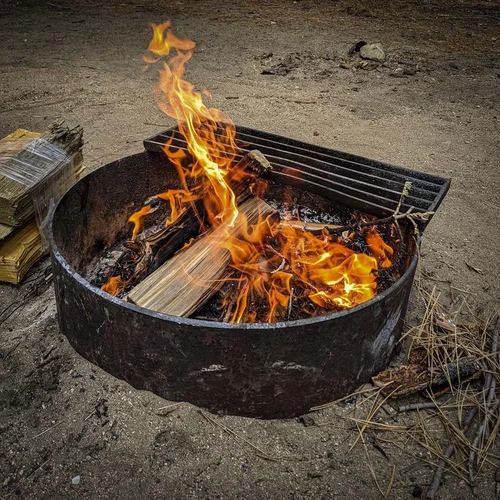
People usually picture fire spreading by contact: a flame touches something, and that something burns. That is only one of the ways it happens, and it is not the one that catches campers out. The dangerous mechanism is heat travelling across a gap and drying out material until it ignites on its own, with nothing ever touching the flames.
Yes, a campfire can make nearby wood catch fire without any flame reaching it. Radiant heat travels outward from the fire in straight lines and is absorbed by whatever it strikes. Wood heated this way first dries, then begins releasing flammable gases somewhere around 500 to 600 degrees F, and those gases can ignite from a stray spark or simply reach a temperature where they combust. The process is slow enough that nothing appears to be happening for a long time, which is exactly why people underestimate it. Clearance, not vigilance, is what prevents it.
In short: radiant heat dries and then ignites wood at a distance, slowly enough that you will not notice until it matters.
The National Park Service puts a number on the practical version of this, advising campers to keep tents, gear and anything flammable at least 15 feet from the fire pit and upwind of it, and warning that whitish gray coals can hold heat for hours and flare up again if the wind picks up.
Below: how heat actually moves, why distance matters so much, which materials ignite at a distance, how wind and embers change the picture, and the clearances and habits that keep a campfire contained.
Key Takeaways
- Radiant heat can ignite wood across a gap, with no flame contact at all.
- Wood releases flammable gases around 500 to 600 degrees F, and those gases are what burn.
- Radiant heat falls off roughly with the square of distance, so doubling the gap cuts it to a quarter.
- Prolonged moderate heat is more dangerous than brief intense heat, because it dries wood first.
- Embers carried by wind start fires far beyond the radiant heat zone.
- Fifteen feet of clearance from tents and gear is a widely used minimum, and more is better.
- Gray coals hold heat for hours and can reignite long after flames are out.
Gear for Containing a Fire Properly
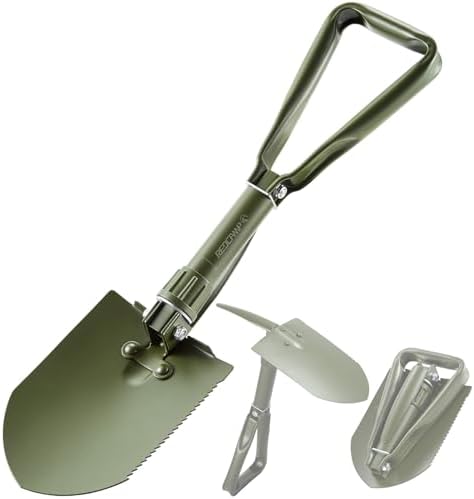
Containment is what turns a campfire from a hazard into a controlled one. A proper ring keeps fuel together, a screen stops ember travel, and gloves let you move burning wood rather than leaving it where it has become a problem.
If you have a permanent fire area at home, a steel ring or liner is the single most useful addition, because it concentrates the fire and keeps the heat going upward rather than outward.



The Three Ways Heat Moves
Understanding this makes everything else obvious. Heat travels by conduction, which needs direct contact; by convection, which carries heat upward in rising air; and by radiation, which travels outward in straight lines and needs no contact at all. A campfire does all three simultaneously.
Conduction is what people worry about and is rarely the problem outdoors, because soil and stone conduct heat poorly. Convection matters mostly upward, which is why branches overhead are a genuine hazard and why rising heat carries embers away from the fire.
Radiation is the one that catches people out. It is why you feel warmth on your face across a campsite, and why that warmth is also reaching the woodpile, the tent and the chair you left close by. Radiant heat does not care what is between the fire and the object unless something physically blocks the line of sight.
| Mechanism | How it travels | What it threatens | What stops it |
|---|---|---|---|
| Radiation | Straight lines outward from the flame | Tents, woodpiles, chairs within line of sight | Distance, or a solid object blocking the line |
| Convection | Rising hot air above the fire | Overhanging branches and tarps | Not lighting fires under anything |
| Conduction | Direct contact through material | Anything touching burning wood or hot stones | Keeping material out of and off the fire |
| Ember transport | Carried on wind, sometimes far | Dry vegetation well beyond the fire | A spark screen, a small fire, and watching the wind |
Why Wood Ignites Without Being Touched
Wood does not burn in the way people imagine. The solid material itself does not catch; what burns are flammable gases released as the wood is heated, a process called pyrolysis. That is why a flame appears to hover slightly above a burning log rather than sitting on it.
Heating wood drives off moisture first, which is why damp wood hisses and steams before it burns. Once dry, continued heating breaks the wood down chemically and releases those gases, somewhere in the region of 500 to 600 degrees F. Give those gases an ignition source, or enough temperature, and they combust.
Radiant heat from a campfire can take wood through that entire sequence at a distance. The process is gradual: a woodpile three feet from a fire does not ignite in a minute, it dries over an hour or two and then becomes something that a drifting ember will light instantly. That slowness is exactly why people conclude it is fine.
How Far Does the Heat Reach?
Radiant heat intensity falls off roughly with the square of the distance from the source. In practical terms, doubling your distance from a fire cuts the radiant heat you receive to about a quarter. That relationship is why clearance works so well as a control measure.
It also explains why the first few feet matter enormously and the later ones matter less. Moving a woodpile from two feet to four feet from a fire is a far bigger improvement than moving it from twelve feet to fourteen. Most of the risk lives very close to the flames.
Fire size is the other variable, and it scales fast. A large fire radiates far more heat in every direction, which pushes the risk zone outward and the seating back. Keeping a campfire small is not just about fuel economy; it directly shrinks the area where heat is a problem.
Embers Are the Other Half of the Problem
Radiant heat is bounded by distance, but embers are not. Rising convection currents lift glowing fragments out of a fire, wind carries them, and they land somewhere that may be far outside any clearance you set. That is the mechanism behind most escaped campfires.
What makes this dangerous is the combination with radiant drying. Dry grass or leaf litter that has been warmed by the fire is primed, and a single ember that would die harmlessly on damp ground will ignite it instantly. The two mechanisms work together.
Wind is the variable that turns a contained fire into an uncontained one, and it changes faster than people adjust. An evening breeze that picks up after dark increases ember travel, pushes flames sideways and fans the fire into burning hotter, all at once.
Setting Up So It Does Not Happen
All of the theory reduces to a handful of habits, and the useful thing about them is that they are decisions made before the fire is lit rather than judgements made while it burns. Clearance is far more reliable than vigilance.
- Use an existing fire ring. Established rings sit where the surrounding ground has already been cleared and assessed. Building a new one puts fire somewhere nobody has checked.
- Clear the ground around it. Sweep back dry leaves, pine needles, twigs and duff for several feet in every direction, down to bare soil or mineral earth where you can.
- Set your clearances before lighting. Tents, gear, firewood stacks and chairs go at least 15 feet away and upwind. Measure it the first few times rather than estimating.
- Look up as well as around. Check for overhanging branches directly above the fire. Rising heat dries foliage overhead long before anything visible happens.
- Keep the fire small. A small fire radiates less heat, throws fewer embers and is far easier to extinguish. Size is the variable you control most directly.
- Stack spare firewood upwind and well back. A woodpile close to a fire is exactly the slow-drying scenario that leads to ignition at a distance, and it catches drifting embers too.
- Watch the wind and stop adding fuel early. If wind builds, let the fire burn down rather than feeding it. Stop adding wood well before you intend to turn in.
- Drown, stir and drown again. Spread the coals, pour water slowly over everything, stir the ashes, and pour again until it is cold to the touch.
If you are building a permanent fire area, the construction matters as much as the clearances: see how to build a stone fire pit.
What Ignites, and How Easily
Not everything near a fire is equally at risk, and knowing the order helps you prioritise what to move. Fine, dry, low-density material goes first because it has enormous surface area relative to its mass and heats through almost instantly.
| Material | Risk level | Why |
|---|---|---|
| Dry grass, leaf litter, pine needles | Highest | Fine and dry; a single ember is enough |
| Synthetic tent fabric and sleeping bags | Very high | Melts and ignites readily, and often sits close by |
| Stacked kindling and small sticks | High | Dries quickly under radiant heat, then catches easily |
| Seasoned firewood pile | Moderate | Slow to reach ignition, but will get there with time |
| Green or damp wood | Lower | Moisture must be driven off first, which takes longer |
| Overhanging live branches | Underestimated | Convection heats them directly from below |
| Chairs, tarps and camp furniture | Varies | Synthetic fabric and plastic melt well before wood ignites |
Synthetic camping fabrics deserve particular attention. They melt at temperatures well below the ignition point of wood, so a tent or sleeping bag can be ruined by radiant heat that is nowhere near enough to set wood alight. Sparks landing on fleece are a frequent and avoidable loss.
Do
- Keep tents, gear and woodpiles at least 15 feet away and upwind
- Clear flammable ground cover back from the ring before lighting
- Check directly overhead for branches before you start
- Keep the fire small and contained within an existing ring
- Keep water within arm reach for the entire burn
- Drown and stir the ashes until they are cold to the touch
Don’t
- Do not stack firewood next to the fire to dry it out
- Do not light a fire under overhanging branches or a tarp
- Do not leave a fire unattended, even briefly
- Do not assume a fire is out because the flames have gone
- Do not bank soil over coals and walk away, since soil insulates
- Do not keep feeding a fire as wind builds
Honest Limits
The temperature figures here are general ranges rather than precise thresholds. Ignition depends on wood species, moisture content, density, how long the material has been heated and whether an ignition source is present, so the same conditions produce different outcomes in different places.
Clearance distances are similarly guidance rather than guarantees. Fifteen feet is a widely used minimum for tents and gear, but a large fire, dry conditions, strong wind or fine fuel nearby all argue for considerably more. Local rules may also specify their own figures, and those take precedence.
This article also assumes a normal recreational campfire. Burn piles, large bonfires and anything involving accelerants are different propositions entirely, with their own rules and risks that this guidance does not cover.
Stay Safe Out There
Check current fire restrictions before planning any fire at all. They change through the season, often quickly during dry spells, and a campfire that was legal when you booked may be banned when you arrive. Posted restrictions and ranger instructions take precedence over anything written here.
Keep water within arm reach for the entire time a fire is burning, and never leave it unattended even briefly. If a fire escapes and is beyond what a bucket can handle, note your location, move upwind and away, and call 911. Where there is no signal, find the campground host or nearest ranger station.
For burns, cool the area with clean running water rather than ice, cover loosely, and seek medical help for anything beyond a small superficial burn, for burns on hands, face or joints, and for any burn on a child. Remember that a stone ring and nearby rocks stay hot long after the flames are out.
The National Park Service publishes detailed guidance on building, feeding and extinguishing campfires, including the 15 foot clearance figure and the warning about gray coals holding heat. For lighting the fire itself, see lighting a fire without matches, and what to pack for tent camping covers the rest of the kit.
Disclaimer: this article is general outdoor information, not safety or fire-prevention advice. Conditions, materials and local rules vary, and you are responsible for any fire you light. Check local restrictions, ask a ranger when you are unsure, and seek professional medical help for any burn that concerns you.
Frequently Asked Questions
Will a campfire make nearby wood catch fire?
Yes, it can, without any flame contact. Radiant heat dries the wood and then drives off flammable gases, which ignite from a stray ember or from reaching ignition temperature. The process is slow, which is why it is easy to miss.
How far does radiant heat from a campfire travel?
Intensity falls off roughly with the square of distance, so doubling your distance cuts the heat to about a quarter. The first few feet matter enormously; beyond about fifteen feet the radiant risk drops off sharply for a normal campfire.
At what temperature does wood catch fire?
Wood begins releasing flammable gases somewhere around 500 to 600 degrees F, and it is those gases that burn rather than the solid wood. The exact figure varies with species, density and how long the wood has been heated.
How far should a tent be from a campfire?
At least 15 feet, and upwind, which is the figure the National Park Service uses. Synthetic tent fabric melts at temperatures well below what wood needs to ignite, so tents are at risk before anything else is.
Can a woodpile near the fire catch fire?
Yes, and it is a common way it happens. Radiant heat dries the stack over an hour or two, and then a drifting ember lands on material that is primed to catch. Stack spare wood upwind and well back.
Why do people say prolonged low heat is dangerous?
Because repeated or sustained heating drives out moisture and chemically alters the wood, progressively lowering the temperature at which it will ignite. Material near a regular fire can eventually catch at temperatures that would not affect fresh wood.
Do embers cause more fires than radiant heat?
In terms of escaped fires, yes. Radiant heat is bounded by distance, but wind carries embers well beyond any clearance. The two combine, since radiant heat dries nearby material that an ember then ignites.
Are overhanging branches really a risk?
Yes, and they are frequently overlooked because people look around rather than up. Convection carries heat straight upward, drying foliage directly above the fire long before anything visible happens.
How long do coals stay dangerous?
Hours. Whitish gray coals hold heat long after flames have gone and can flare up if wind picks up. Spread them, drown with water, stir the ashes and drown again until everything is cold to the touch.
Does a fire ring stop heat spreading?
It helps considerably by containing the fuel and directing heat upward rather than outward, and it keeps burning material from rolling. It does not stop radiant heat reaching things within line of sight, so clearances still apply.
The Bottom Line
Yes, a campfire will ignite wood it never touches, and the reason is radiant heat rather than flame. Heat crosses the gap, drives the moisture out, and then breaks the wood down into flammable gases that need only an ember or enough temperature to catch. What makes this dangerous is the timescale: nothing appears to happen for an hour or two, which is long enough for most people to conclude the woodpile is fine where it is.
The fix is geometry rather than attention. Keep tents, gear and spare firewood at least fifteen feet away and upwind, clear the ground around the ring, check what is directly overhead, and keep the fire small, because radiant heat falls off sharply with distance and fire size scales it right back up. Then put it out properly: spread, drown, stir, drown again, and leave only ashes cold enough to touch.