
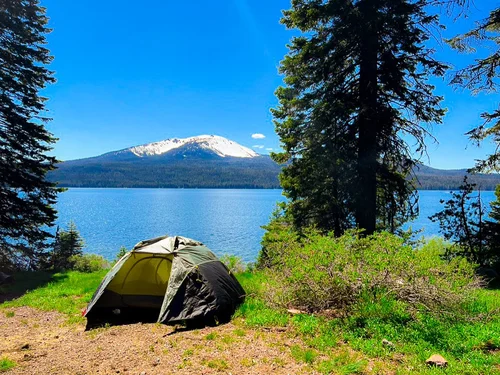
Diamond Lake sits at around a mile high in the Oregon Cascades, ringed by conifer forest with Mount Bailey on one side and Mount Thielsen on the other. It is one of the busiest recreation areas in the Umpqua National Forest, which is good news for facilities and bad news for anyone who turns up on a July Friday hoping to find a site.
Yes, you can tent camp at Diamond Lake. The main option is Diamond Lake Campground on the east shore, which the Forest Service lists as offering 51 lakeshore camping sites plus 187 inshore sites, with potable water and picnic tables available. Sites are reserved through Recreation.gov rather than claimed on arrival during the busy season, the campground is run by a concessionaire under permit from the Umpqua National Forest, and the maximum length of stay anywhere on the Forest is 14 days. Check the Forest Service alerts page before you travel, because closures and restrictions change through the season.
In short: yes, through Diamond Lake Campground, reserved in advance, with a 14-day stay limit and conditions that change year to year.
The Forest Service is the authority here, and its guidance is worth following closely. It notes that campgrounds around Diamond Lake and Lemolo Lake fill quickly in summer, advises making reservations ahead and having a backup plan, and asks visitors to store food properly to keep wildlife wild. Current alerts have included a blue-green algae precaution for Diamond and Lemolo Lakes.
Below: the campgrounds around the lake, how reservations and stay limits work, the rules you will be held to on site, what the weather does at this elevation, the gear that matters here specifically, and what to check before you commit to the drive.
Key Takeaways
- Diamond Lake Campground on the east shore is the main tent option, listed at 51 lakeshore sites and 187 inshore sites.
- Reservations go through Recreation.gov, and the Forest Service advises booking ahead because summer sites fill fast.
- Maximum length of stay anywhere on the Umpqua National Forest is 14 days, and 28 days in a calendar year.
- Check-in is 1 p.m., check-out is 11 a.m., and quiet hours run from 10 p.m. to 8 a.m.
- Fireworks are prohibited and OHV or ATV use is not allowed within the campground.
- Store food properly. The Forest Service specifically asks visitors here to keep wildlife wild.
- Always check the current alerts and fire danger status before you travel, since both change through the season.
Gear That Earns Its Place at Diamond Lake
This is a mile-high lakeside campground with cold nights even in midsummer, developed facilities, and a long paved trail around the water. The gear below reflects those conditions rather than a generic camping list.
Potable water is available at the campground itself, but a filter is worth carrying for day hikes and for the backup it gives you if a water system is down during your stay.


Where You Can Actually Pitch a Tent
Diamond Lake Campground is the main answer. The Forest Service describes it as sitting among conifer trees along the east shore of the mile-high lake, with 51 lakeshore camping sites and 187 inshore sites. That is a large campground by any measure, and it supports a correspondingly large summer crowd.
It is operated by a concessionaire under permit from the Umpqua National Forest, which matters practically: the booking system, fees and on-site staffing are handled by the concessionaire while the land and the regulations remain Forest Service responsibility. Potable water and picnic tables are available at the site.
Other campgrounds sit around the lake, including Broken Arrow set back from the shore in lodgepole pine forest. Availability varies from season to season, and at the time of writing the Forest Service listed Broken Arrow as closed for the 2026 summer season. That is exactly the kind of detail that changes, so verify before you plan around any specific campground.
Reservations, Fees and Stay Limits
Reservations run through Recreation.gov. The Forest Service is direct about demand, noting that the campgrounds around Diamond Lake and Lemolo Lake fill quickly in summer and advising visitors to make reservations ahead of time and have a backup plan in case sites are full.
Stay limits are set at the forest level rather than the campground level. Visitors cannot camp, occupy or leave camping equipment in a single location for longer than 14 consecutive days, and cannot camp on the Umpqua National Forest for more than 28 days in a calendar year.
| Item | What the Forest Service lists | Why it matters |
|---|---|---|
| Reservations | Through Recreation.gov | Turning up without one in summer is a gamble |
| Check-in and check-out | Check-in 1 p.m., check-out 11 a.m. | Plan arrival around the drive from Roseburg or Bend |
| Quiet hours | 10 p.m. to 8 a.m. | A 238-site campground enforces this for a reason |
| Maximum stay | 14 days in one location | 28 days per calendar year across the forest |
| Fireworks | Prohibited | Applies regardless of current fire danger level |
| OHV and ATV use | Prohibited in the campground | Riding areas are elsewhere on the forest |
| Payment | Cash and check no longer accepted at forest-operated sites | Bring a card |
One more practical note: the Diamond Lake Visitor Center has been listed as closed for the 2026 season due to repairs, and the Toketee Ranger Station is closed for visitor services such as map and permit sales. For passes and permits, the Forest Service directs people to the North Umpqua Ranger Station instead.
Lakeshore or Inshore: Choosing a Site
With 51 lakeshore and 187 inshore sites, the first real decision is whether you want the water view or the shelter. Lakeshore sites give you the obvious thing, along with more wind coming off a mile-high lake and more foot traffic past your tent from people heading to the water.
Inshore sites sit among the conifers, which means more wind protection, more shade on hot afternoons, and generally a quieter night. The Forest Service guidance for the area suggests selecting a campsite on the edge of the campground and away from the shoreline wherever possible, which is both a wildlife and a crowding consideration.
Do
- Book early, and have a second campground in mind as a backup
- Choose an inshore site if wind or an early night matters to you
- Check the Forest Service alerts page again a day or two before you leave
- Store food in hard-sided containers or your vehicle, not in the tent
- Bring a card, since forest-operated sites no longer take cash or check
- Pack layers for a sharp overnight temperature drop at elevation
Don’t
- Do not plan on finding a walk-up site on a summer weekend
- Do not bring fireworks, which are prohibited regardless of conditions
- Do not ride OHVs or ATVs inside the campground
- Do not assume last year rules still apply, since closures change annually
- Do not leave food, cookware or scented items out overnight
- Do not ignore posted algae advisories when deciding whether to swim
Weather at a Mile High
Elevation is the detail most first-time visitors underestimate. Diamond Lake sits at roughly a mile above sea level, and that produces a large daily temperature swing: comfortable or hot afternoons followed by nights that can approach or drop below freezing well outside winter.
The mechanism is simple. Thin, dry mountain air holds little heat, so once the sun drops the ground radiates warmth away quickly with nothing to trap it. A sleeping bag chosen for the daytime temperature will leave you cold at three in the morning, which is the most common mistake made here.
Snow lingers at this elevation well into spring and arrives early in autumn, which affects road access as much as camping comfort. The season is genuinely shorter than the calendar suggests, so check current conditions rather than assuming a campground is reachable in May or October.
| Season | Typical daytime feel | Night to plan for | What to bring |
|---|---|---|---|
| Late spring | Cool, snow may still linger | Below freezing | Winter-weight bag, insulated mat, check road access |
| Early summer | Warm afternoons | Cold, often near freezing | A 20F bag, hat and insulating layer for the evening |
| Midsummer | Hot in open sun | Cold enough to wake you | A 20F to 30F bag, mat with real R-value |
| Early autumn | Cool and short daylight | Freezing likely | Winter-weight bag, extra layers, headlamp |
| Late autumn onward | Snow arrives early | Well below freezing | Check whether access roads are open at all |
Planning the Trip Step by Step
Most problems at a popular, concessionaire-run campground come from planning assumptions rather than from the camping itself. Working through the sequence below removes nearly all of them, and the first step is the one people skip.
- Check current alerts first. Open the Umpqua National Forest alerts and current conditions pages before anything else. Fire restrictions, road closures, algae advisories and campground closures all appear there and change through the season.
- Pick your campground. Diamond Lake Campground on the east shore is the largest and the main tent option. Other campgrounds sit around the lake, but availability varies year to year, so confirm which are open for your dates.
- Reserve through Recreation.gov. Book as far ahead as the system allows. The Forest Service specifically warns that campgrounds around Diamond Lake fill quickly in summer and advises having a backup plan.
- Choose a site position deliberately. Lakeshore sites have the view and the wind; inshore sites among the trees are more sheltered and usually quieter. Forest Service guidance suggests choosing sites on the campground edge and away from the shoreline where possible.
- Plan for cold nights. At around a mile of elevation, overnight temperatures drop sharply even after hot days. Pack a bag rated colder than you think you need and an insulated sleeping mat.
- Sort food storage before you arrive. Bring hard-sided containers or a plan to store food in your vehicle. The Forest Service asks visitors here to store food properly to keep wildlife wild.
- Confirm fire rules on arrival. Fire danger status is posted at the campground and on the Forest Service site. Restrictions can tighten between booking and arrival, so check again rather than assuming.
For the kit list itself, our guides to what to pack for tent camping and must-have tent camping items cover the general case, and family camping tents worth considering is a good starting point if you are buying a tent for a drive-in site like this one.
Dispersed Camping Nearby
If the campground is full, dispersed camping elsewhere on the Umpqua National Forest is an option, but not immediately around the lake. Forest Service guidance states that you generally cannot camp within a mile of developed recreation areas such as trailheads or picnic areas, which rules out the obvious spots near a busy destination.
Dispersed campers get no facilities at all: no toilets, no water, no trash removal. The Forest Service asks visitors to practise Leave No Trace by using existing sites where possible, packing out all trash, camping 100 feet from water and digging a 6 to 8 inch hole for human waste.
The same 14-day and 28-day limits apply, and so do forest closures and fire restrictions, which matter more when dispersed because there is nobody on site to tell you the rules changed. Check before you drive out on a forest road looking for a spot.
Honest Limits
Everything in this article that comes from the Forest Service was accurate on its published pages at the time of writing, but campground details are among the fastest-changing information in outdoor writing. Site counts, operating seasons, fees, which campgrounds are open and which facilities are running all change from year to year.
Closures are the clearest example. Broken Arrow Campground was listed as closed for the 2026 summer season and the Diamond Lake Visitor Center closed for repairs, and both of those statuses will change. Nothing here replaces checking the current Forest Service alerts page for your actual travel dates.
We also have not visited to verify conditions on the ground. The gear recommendations are based on the published characteristics of the site, principally its elevation and the fact that it is a developed drive-in campground, rather than on testing anything there.
Stay Safe Out There
Check the current alerts and fire danger status before you travel and again when you arrive. Fire restrictions in the Oregon Cascades tighten quickly in dry spells, and a campfire that was legal when you booked may not be when you turn up. Posted restrictions take precedence over anything written here.
Water quality is a live issue at this lake specifically. Active alerts have included a blue-green algae precaution for Diamond and Lemolo Lakes, which affects swimming and pets as well as drinking. Algae advisories are posted and updated by the managing agencies, so read the notices on site rather than judging by how the water looks.
The authoritative source for all of this is the Forest Service page for the site itself: Diamond Lake Campground, Umpqua National Forest. Check it before you go, because conditions and closures change through the season.
Disclaimer: this article is general outdoor information, not safety, medical or legal advice. Campground rules, closures and conditions change, and you are responsible for decisions made on your trip. Check the official Forest Service pages, ask a ranger when you are unsure, and seek professional medical help for any symptom that concerns you.
Frequently Asked Questions
Can you tent camp at Diamond Lake?
Yes. Diamond Lake Campground on the east shore is the main option, listed by the Forest Service as offering 51 lakeshore sites and 187 inshore sites, with potable water and picnic tables. Sites are reserved through Recreation.gov.
Do I need a reservation?
In practice, yes, for summer. The Forest Service warns that campgrounds around Diamond Lake fill quickly in the summer season, advises making reservations ahead through Recreation.gov, and suggests having a backup plan in case sites are full.
How long can I stay?
The maximum length of stay anywhere on the Umpqua National Forest is 14 consecutive days in one location, and no more than 28 days in a calendar year. That applies to developed campgrounds and dispersed camping alike.
What are the check-in and quiet hours?
Check-in is 1 p.m. and check-out is 11 a.m. Quiet hours run from 10 p.m. to 8 a.m. In a campground with well over two hundred sites, those quiet hours are taken seriously by the staff and by your neighbours.
Is there drinking water at the campground?
The Forest Service lists potable water as available at Diamond Lake Campground, along with picnic tables. Carrying a filter as backup is still sensible, both for day hikes and in case a water system is out during your stay.
Can I have a campfire?
It depends entirely on current fire danger status and any public use restrictions in effect, which change through the season. Check the alerts on the Forest Service page before you travel and read the postings when you arrive. Fireworks are prohibited at all times.
Is the lake safe to swim in?
Check current advisories. Active alerts have included a blue-green algae precaution for Diamond and Lemolo Lakes, which affects swimming and pets. Algae conditions are not reliably visible, so follow the posted notices rather than your own judgement.
How cold does it get at night?
Colder than most visitors expect. The lake sits at around a mile of elevation, so nights can approach or drop below freezing well outside winter, even after a hot day. Bring a bag rated lower than the forecast and an insulated sleeping mat.
Are dogs allowed?
Yes, with conditions. Forest Service guidance asks that dogs be kept on a leash no more than six feet long during the day, that animals are not allowed to run loose in recreation areas, and that pets are kept in a vehicle or tent at night.
Can I camp for free near Diamond Lake?
Dispersed camping is allowed elsewhere on the forest but generally not within a mile of developed recreation areas such as trailheads and picnic areas, which excludes the area immediately around the lake. There are no facilities, and Leave No Trace practices apply.
The Bottom Line
Diamond Lake is a straightforward yes for tent camping, with the caveat that it is a popular, highly developed destination rather than a quiet corner of the Cascades. Diamond Lake Campground offers a large number of lakeshore and inshore sites with potable water and picnic tables, reserved through Recreation.gov, under a 14-day stay limit. Book early, pick inshore if you value shelter and quiet, and bring a card rather than cash.
The part that needs real attention is not the camping, it is the checking. Campground closures, fire restrictions, algae advisories and visitor centre hours all change from season to season, and at least two of those were active at the time of writing. Read the Forest Service page for your actual dates, plan for a cold night at elevation, store your food properly, and the rest of the trip takes care of itself.