
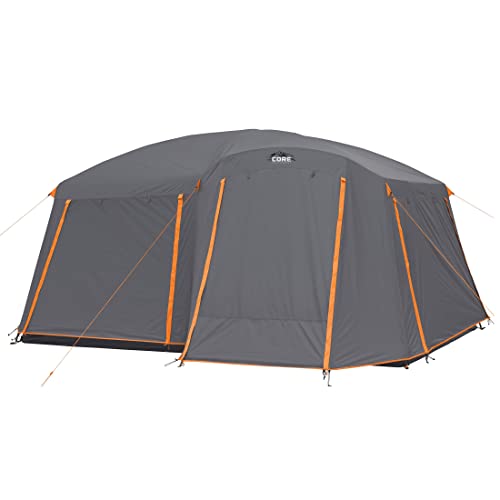
Winter camping punishes gear that was good enough in summer. The same tent that shrugged off July rain can sag under wet snow, frost on the inside overnight, and leave you brushing ice onto your sleeping bag every time you move. Choosing a winter tent is less about waterproof ratings than about geometry, pole strength and how the tent handles the water you breathe out.
A 4-season tent is built to shed snow and resist wind rather than to keep you warm. The differences are structural: more pole crossings and stronger poles to carry snow load, a steeper profile so snow slides off instead of accumulating, a fly that reaches closer to the ground, and far less mesh in the inner so spindrift cannot blow through. None of that adds insulation. A 4-season tent is a few degrees warmer than a summer tent at best, and what actually keeps you warm is your sleeping bag and the mat underneath you.
In short: buy for snow load and wind, expect no warmth from the tent itself, and plan your ventilation deliberately.
The National Park Service points out that conditions change faster than forecasts and that local rules and closures vary by park and season. Winter adds avalanche terrain, frozen access roads and short daylight to that list, so checking with the managing agency before you travel matters more in January than it does in July.
Below: what separates a true 4-season tent from a sturdy 3-season one, how snow loading and wind actually break tents, why condensation is the problem nobody warns you about, six tents worth considering, and how to pitch and look after one in the cold.
Key Takeaways
- A 4-season tent resists snow and wind. It does not insulate, and it will not make a cold night warm on its own.
- Pole count and pole crossings matter more than fabric ratings, because snow load is what collapses tents.
- Steep walls shed snow; shallow domes collect it, and wet snow is far heavier than people expect.
- Less mesh keeps spindrift out but traps moisture, so vents must be used deliberately even when it is freezing.
- Condensation and frost inside the tent are the normal winter failure, not a sign the tent leaks.
- Never run a stove, heater or lantern inside a closed tent. Carbon monoxide is the most common winter camping fatality.
- Your sleeping mat R-value matters more for warmth than any feature on the tent.
Winter and 4-Season Tents Worth Considering
These are 4-season and cold-weather tents currently sold on Amazon, spanning solo backpacking shelters through to a four-person family option. We have deliberately excluded hot tents with stove jacks, because recommending a tent designed around an internal fire raises safety questions this guide cannot responsibly cover.
Check the listed pole material, pole count and packed weight against the trips you actually do. A tent that is perfect for a sheltered forest pitch may be the wrong choice entirely for an exposed ridge.


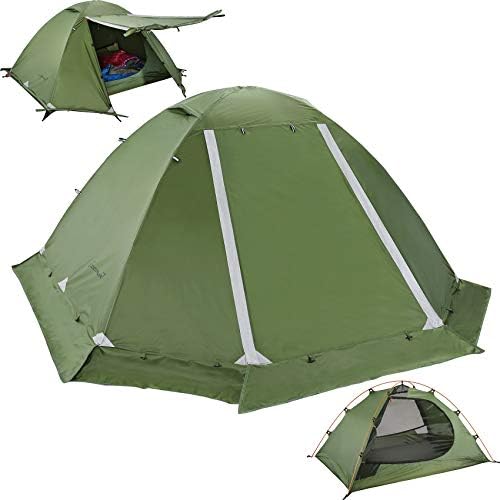

What 4-Season Actually Means
The label is marketing shorthand and it is applied loosely, so it pays to know what you are actually looking for. A genuine 4-season tent is designed around two forces that barely matter in summer: the downward weight of accumulated snow, and sustained wind that a 3-season tent will flex and eventually fail under.
Structurally that means more poles, more crossings where poles intersect, and usually thicker or higher-grade aluminium. Each crossing point is a node that resists deformation, which is why a four-pole winter tent holds its shape under a load that would flatten a two-pole summer dome.
The second difference is profile. Steep, near-vertical upper walls shed snow because it cannot find purchase; shallow dome roofs collect it. A tent that sheds snow passively while you sleep is doing the single most important job a winter shelter has.
Three-Season and Four-Season Tents Compared
These two categories get conflated constantly, usually by listings that describe a summer tent as suitable for all conditions. The distinction is real and it shows up in specific, checkable details rather than in the marketing copy.
| Feature | 3-season tent | 4-season tent | Why it matters in winter |
|---|---|---|---|
| Pole count | Usually two, sometimes three | Three to five, with more crossings | Crossings resist snow load and wind deformation |
| Wall profile | Shallow dome or tunnel | Steep, near-vertical upper walls | Steep walls shed snow instead of collecting it |
| Inner fabric | Large mesh panels for airflow | Mostly solid fabric with small vents | Mesh lets spindrift blow straight through |
| Fly coverage | Often stops short of the ground | Reaches close to or onto the ground | Keeps drifting snow out of the vestibule |
| Vestibule | Small, for boots | Larger, for cooking shelter and gear | Winter kit is bulkier and must stay outside |
| Weight | Lighter for the same floor area | Heavier because of poles and fabric | You carry the difference every trip |
One thing that does not differ is insulation. Neither type insulates meaningfully. A tent traps a thin layer of still air and blocks wind, which is worth a few degrees against the outside temperature and no more. Anyone promising a warm tent is describing a stove tent or selling you something.
Snow Load and Wind: How Tents Actually Fail
Fresh dry snow weighs very little, which is why people underestimate it. Wet snow, or dry snow that has sat and settled, weighs several times more. A modest accumulation across the roof of a tent can reach a load the poles were never designed for, and failure is usually sudden rather than gradual.
The practical defence is partly the tent and partly you. A steep-walled tent sheds much of it automatically. The rest comes off when you knock the fly from inside, which is why experienced winter campers wake periodically during heavy snowfall rather than sleeping through it.
Wind fails tents differently. Sustained gusts flex poles repeatedly until a pole section fails or a guy-out point tears. Guy lines are what stop that flexing, so using every one of them is not optional in winter, and the smallest cross-section of the tent should face the prevailing wind.
Condensation Is the Problem Nobody Warns You About
A sleeping adult exhales roughly a pint of water overnight. In summer that vapour drifts out through mesh panels. In a winter tent with solid inner walls and the vents closed against spindrift, it has nowhere to go, so it condenses on the coldest surface it can find and then freezes.
The result is a layer of frost on the inside of the fly that showers down on your sleeping bag every time you brush against it. Once a down bag gets damp it loses loft and stops insulating, which is how a gear annoyance becomes a genuine cold-weather problem.
| What you see | Cause | What to do |
|---|---|---|
| Even frost layer across the inner fly | Normal condensation, frozen overnight | Open high and low vents, knock frost out before packing |
| Damp patch where fly touches inner | Fabric contact wicking moisture through | Retension guy lines so the fly stands clear |
| Wet gear in the vestibule | Snow carried in on boots, melting | Brush off everything before it comes under cover |
| Water tracking along a seam | Failed or unsealed seam tape | Seam sealer at home, before the next trip |
| Damp sleeping bag underside | Vapour condensing against a cold mat | Higher R-value mat, vapour barrier liner in deep cold |
Pitching on Snow and Frozen Ground
Standard pegs are useless in snow. They pull straight out under tension because snow offers no resistance to a thin vertical stake. The technique that works is a deadman anchor: something buried horizontally and loaded from the middle, so the whole buried mass resists the pull.
Preparing the platform matters just as much. Stamping snow flat and then leaving it for fifteen minutes lets it sinter, which is the process where compressed snow crystals bond into a firm, load-bearing surface. Pitching on unconsolidated snow means waking up in a body-shaped trough.
- Stamp out a platform. Pack the snow down with your boots or skis across the whole footprint, then wait fifteen minutes. Compressed snow sinters and hardens, giving you a firm, level base.
- Build a wind break if exposed. On open ground, pile a low wall of snow on the windward side, a pace or two back from the tent so drifting snow collects there rather than against the fabric.
- Orient the strongest end into the wind. Put the end with the most pole crossings, usually the foot, toward the prevailing wind, and keep the door on the sheltered side.
- Use deadman anchors. Normal pegs do not hold in snow. Bury stakes, sticks or stuff sacks filled with snow horizontally, about a foot down, with the guy line looped around the middle.
- Tension everything, then tension again. Guy out every point. Fabric slackens as temperatures drop overnight, so retension the fly before you go to sleep.
- Open vents before you settle. Set both high and low vents open, even if it feels cold. Closed vents guarantee a frost layer on the inner by morning.
- Clear snow through the night. Knock accumulated snow off the fly from inside every few hours in heavy snowfall. Snow load is what collapses tents, and it builds while you sleep.
On frozen ground rather than snow, the problem reverses: you cannot drive a peg in at all. That is where a freestanding design earns its weight, because the tent holds its shape without tension and can be weighted down with rocks, packs or gear instead of staked.
Do and Do Not in a Winter Tent
Do
- Use every guy line, every night, regardless of the forecast
- Keep both high and low vents open even when it feels too cold
- Brush snow off boots and clothing before bringing them under the fly
- Sleep on a high R-value mat, since the ground steals more heat than the air
- Keep a brush handy to clear frost off the inner before it falls on your bag
- Clear accumulated snow off the fly during heavy snowfall
Don’t
- Do not run a stove, heater or lantern inside a closed tent, ever
- Do not cook in a sealed vestibule without cross-ventilation
- Do not rely on standard pegs in snow, since they will pull out
- Do not pitch in a hollow where cold air pools and drifting snow collects
- Do not pack a tent away frozen and leave it, because ice becomes mould at home
- Do not assume a 4-season label on a listing means a true winter tent
Winter gear choices extend well past the tent. Our list of must-have tent camping items covers the basics in any season, and what to pack for tent camping is the longer checklist to work from before a cold-weather trip.
Looking After a Winter Tent
Cold makes fabric and coatings brittle, and zips are the first casualty. Ice in the teeth will tear a slider off its track if you force it, so clear the teeth with a gloved finger and work the slider slowly rather than yanking. A frozen zip is almost always ice rather than a mechanical fault.
Pole sections become more fragile in deep cold too. Feed shock-corded poles through sleeves rather than letting them snap together under tension, because a section driven hard into a cold joint can split. Assemble each joint by hand before the pole takes any load.
At home, the rule is the same as any other tent but more urgent: dry it completely before storage. A tent packed with ice in it thaws into a damp bundle, and mildew destroys polyurethane coatings permanently. Pitch it indoors or hang it until every seam is dry.
Honest Limits
These are research-based picks drawn from current listing specifications and from what buyers widely report. We have not pitched them in a storm or loaded them with snow, and nothing here should be read as a durability verdict. Makers also revise fabrics and poles between production runs while keeping the same name.
There is a more important limit specific to this category. None of the tents here is an expedition mountaineering shelter, and the gap between a budget 4-season tent and a true high-altitude tent is enormous. For genuinely severe conditions, exposed alpine terrain or prolonged storms, this is not the price bracket to be shopping in.
We also excluded hot tents with stove jacks from this list on purpose. They are a legitimate category with a long history, but recommending a tent designed around an internal fire means taking on carbon monoxide and fire-risk guidance that deserves its own article rather than a paragraph.
Stay Safe Out There
Winter removes most of the margin that makes a summer mistake survivable. Daylight is short, access roads close, batteries fade in the cold and a wet sleeping bag can turn a cold night into an emergency. Plan trips that finish with hours to spare and treat the forecast as the beginning of the research rather than the end.
Know the signs of hypothermia in yourself and others: shivering you cannot control, clumsiness, slurred speech and confusion. The response is to stop losing heat, which means getting out of the wind, replacing wet layers, insulating from the ground and adding warm sugary drinks if the person is fully alert. Seek medical help for anything beyond mild cases.
Check with the managing agency before you travel, not just about weather but about road closures, permits and avalanche conditions in any terrain steep enough to slide. Rangers would rather answer a question than coordinate a rescue, and winter conditions change the answer from week to week.
The National Park Service publishes seasonal guidance that is updated as conditions change, including fire rules that still apply in winter. For milder-weather trips, our guide to family camping tents for the warmer months covers a different set of priorities entirely.
Disclaimer: this article is general outdoor information, not medical, safety or legal advice. Winter conditions are genuinely hazardous, equipment fails, and you are responsible for decisions made on your trip. Check local rules, ask a ranger when you are unsure, and seek professional medical help for any cold-related symptom that concerns you.
Frequently Asked Questions
What makes a tent a true 4-season tent?
More poles and more pole crossings to carry snow load, steeper walls that shed snow, a fly that reaches close to the ground, and a mostly solid inner rather than mesh. The label alone is applied loosely, so check those specifics on the listing.
Will a 4-season tent keep me warm?
Barely. A tent blocks wind and traps a thin layer of still air, which is worth a few degrees at most. Your sleeping bag rating and the R-value of the mat underneath you are what actually determine whether you are warm.
Can I use my 3-season tent in winter?
In sheltered conditions with little snowfall, often yes. The risks are snow load collapsing a two-pole dome and spindrift blowing through mesh panels. Avoid exposed pitches, clear snow off the fly regularly, and do not rely on it in a storm.
Why does the inside of my tent frost over?
Because you exhale about a pint of water overnight and a winter tent has little mesh for it to escape through. It condenses on the cold fly and freezes. Open high and low vents, and brush the frost off before moving around in the morning.
Can I use a heater or stove inside a winter tent?
No. Carbon monoxide is odorless, accumulates fast in enclosed spaces, and poisoning is among the most common causes of death in winter camping. Vents do not make it safe. Cook outside or in a fully open vestibule with air moving through.
How do I stake a tent in snow?
Use deadman anchors. Bury a stake, stick or a stuff sack packed with snow horizontally about a foot down, loop the guy line around its middle, and pack snow over the top. Vertical pegs pull straight out of snow under tension.
What sleeping mat R-value do I need for snow?
Aim for R-5 or higher for camping on snow, and consider stacking two mats, which adds their values together. The ground conducts heat away far faster than cold air does, so mat insulation matters more than most people expect.
Are hot tents with stove jacks a good idea?
They are a real category with a long history, but they introduce carbon monoxide and fire risks that need proper instruction, a working CO alarm and careful stove management. We have left them out of this guide rather than cover that in a sentence.
Should a winter tent be freestanding?
It helps a great deal. On frozen ground you often cannot drive a peg at all, and a freestanding tent holds its shape so you can weight it with packs or rocks instead. On snow, you can still anchor it properly with deadmen.
How do I dry a tent that froze?
Pitch it indoors or hang it up and let the ice thaw and evaporate completely before storage. A tent packed away with ice becomes a damp bundle, and mildew permanently damages the polyurethane coatings that keep it waterproof.
The Bottom Line
Winter tent choice comes down to structure rather than specifications. Count the poles and the crossings, look at how steep the upper walls are, check whether the fly reaches the ground and how much of the inner is mesh. Those four things tell you far more about how a tent will behave under snow and wind than any waterproof rating printed on the listing.
Then plan around what the tent cannot do. It will not keep you warm, so your bag and mat carry that job. It will frost up inside, so ventilate deliberately and sweep the fly before you move. It will collect snow if you sleep through a heavy fall, so wake up and knock it off. Winter camping is comfortable when the tent is doing its job and you are doing yours.