
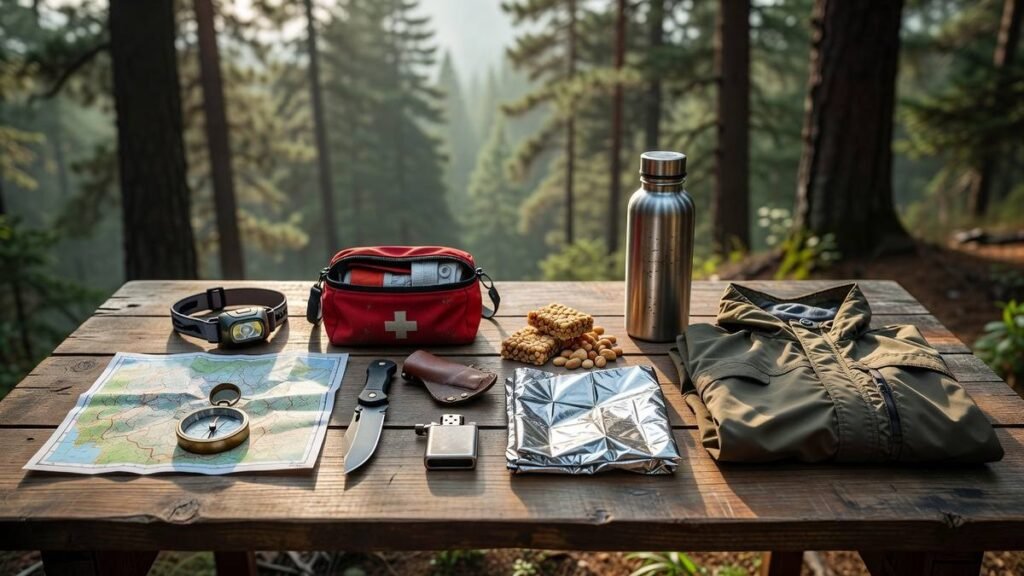
Quick answer: Start with the Ten Essentials. REI lists them as navigation, light, sun protection, first aid, knife and repair tools, fire, shelter, extra food, extra water and extra clothes. Add the day-specific items: your water for the route, snacks, layers for the forecast and a map of the trail. For a day hike, a 10 to 40 liter pack holds all of it.
The Ten Essentials are built around what goes wrong: getting lost, dark, hurt, cold or stuck out overnight. Everything else is comfort.
This guide gives the list, what each item means in practice, and how it changes with the trip.
Related: tent camping gear checklist, where things go in the pack and choosing a backpack.
The Ten Essentials
| System | REI examples |
|---|---|
| Navigation | Map, compass, GPS or phone app, satellite communicator, power bank |
| Light | Headlamp with extra batteries |
| Sun protection | Sunglasses, UPF clothing, sunscreen |
| First aid | Bandages, blister care, sting treatment |
| Knife and tools | Knife plus a gear repair kit |
| Fire | Matches, lighter, fire starter |
| Shelter | Emergency space blanket or lightweight bivy |
| Extra food | Snacks and an additional meal |
| Extra water | Extra capacity and a treatment method |
| Extra clothes | Insulated jacket, rain shell, spare socks |
Day Hike Additions
Water for the route, lunch and snacks, a layer for the forecast, a hat, and your phone with the map downloaded. REI says hikes under two hours may need only a 10 to 20 liter pack, while full-day treks need more room.
Overnight Additions
Tent, sleep system, stove and cook kit, food, water treatment and toiletries, packed by zone: sleep gear at the bottom, dense items in the core, trail needs on top. See the packing guide linked above.
Honest Limits
The Ten Essentials are a framework, not a complete list. Terrain, season and group change what you carry. We have not tested products.
Frequently Asked Questions
What are the Ten Essentials?
Navigation, light, sun protection, first aid, knife, fire, shelter, extra food, extra water, extra clothes.
Do I need all ten on a short hike?
REI frames them as systems to carry on every trip, scaled to the outing.
What navigation should I carry?
Map and compass, plus a phone app or GPS.
What shelter for a day hike?
An emergency space blanket or light bivy.
How much water?
Enough for the route plus extra capacity and a treatment method.
What first aid items?
Bandages, blister care, sting treatment at minimum.
Do I need a knife?
REI lists a knife and a repair kit.
What extra clothes?
An insulated layer, rain shell and spare socks.
What size daypack?
10 to 40 liters for hiking, per REI.
Where does food go overnight?
Core of the pack while hiking; a locker or vehicle at camp in bear country.
Bottom Line
Pack the Ten Essentials first, then the day-specific items.
Scale the pack size to the trip.
Sources: REI, The Ten Essentials; REI, How to Choose Daypacks; NPS, Shenandoah Food Storage.