
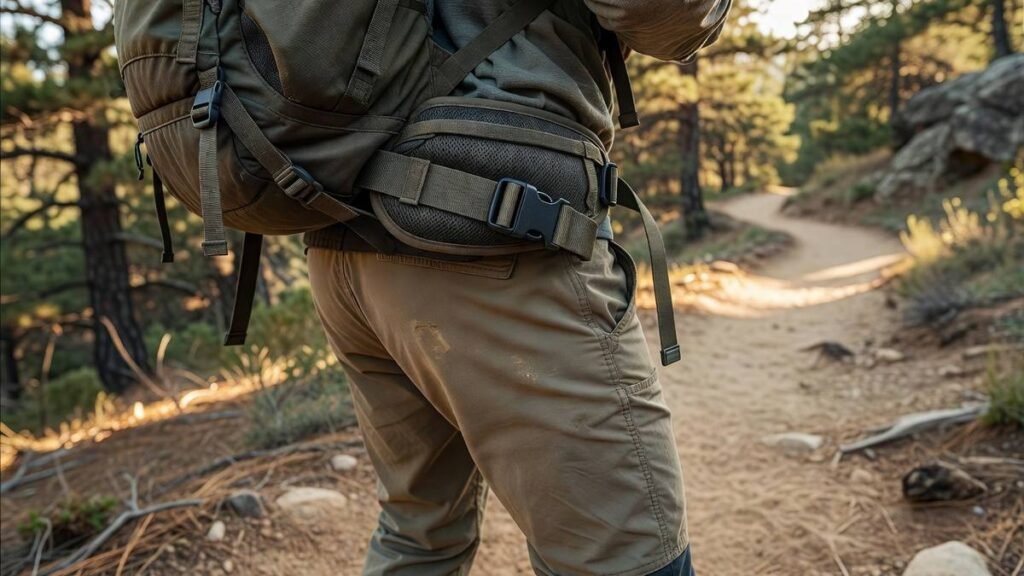
Quick answer: Yes, whenever the pack has real weight in it. REI says your hips should carry 80 percent or more of a backpacking pack weight, and that a hipbelt makes a noticeable difference once the load exceeds about 15 pounds. Left unbuckled, the weight hangs from your shoulders instead.
The waistband, or hipbelt, is not a seatbelt. It is the main load-bearing part of the pack.
This guide explains why and how to set it.
Related: tent camping gear checklist, measuring for pack fit and how much a pack should weigh.
Why It Matters
A backpacking pack is built to transfer load to the hips through the frame and hipbelt. REI says the hips should carry 80 percent or more. Shoulder straps should wrap closely without carrying significant weight. Skip the hipbelt and your shoulders and back take the load.
How to Set It
- Loosen all straps, then put the pack on.
- Position the hipbelt padding on top of your hip bones and tighten snug, not pinching. REI says to leave at least 1 inch of clearance each side of the buckle.
- Tighten the shoulder straps so they wrap without lifting the belt.
- Snug the load lifters to about 45 degrees.
- Clip the sternum strap about 1 inch below the collarbones.
Daypacks and Light Loads
Honest Limits
Fit advice assumes a pack that fits your torso. A wrong-size pack cannot be fixed with the hipbelt alone.
Frequently Asked Questions
Should I buckle the hipbelt?
Yes, for any loaded pack.
How much weight should my hips carry?
80 percent or more, per REI.
When does the hipbelt matter?
Once the load exceeds about 15 pounds.
Where does the belt sit?
On top of the hip bones, not the waist.
How tight?
Snug, not pinching, with 1 inch of clearance at the buckle.
Should shoulder straps be tight?
They should wrap closely without carrying much weight.
What are load lifters?
Straps that pull the top of the pack toward you, at about 45 degrees.
Do daypacks need a hipbelt?
Under about 15 pounds, it mostly stabilizes.
Does the belt hurt my hips?
If it does, the size or position is wrong.
Should I unbuckle on river crossings?
Many hikers do so they can shed the pack if they fall. Decide for yourself.
Bottom Line
Wear the hipbelt. It carries most of the load by design.
Set it on the hip bones first, then adjust the rest.
Sources: REI, How to Choose a Backpack; REI, Backpack Fit: Torso and Hip Size; REI, How to Choose Daypacks.