
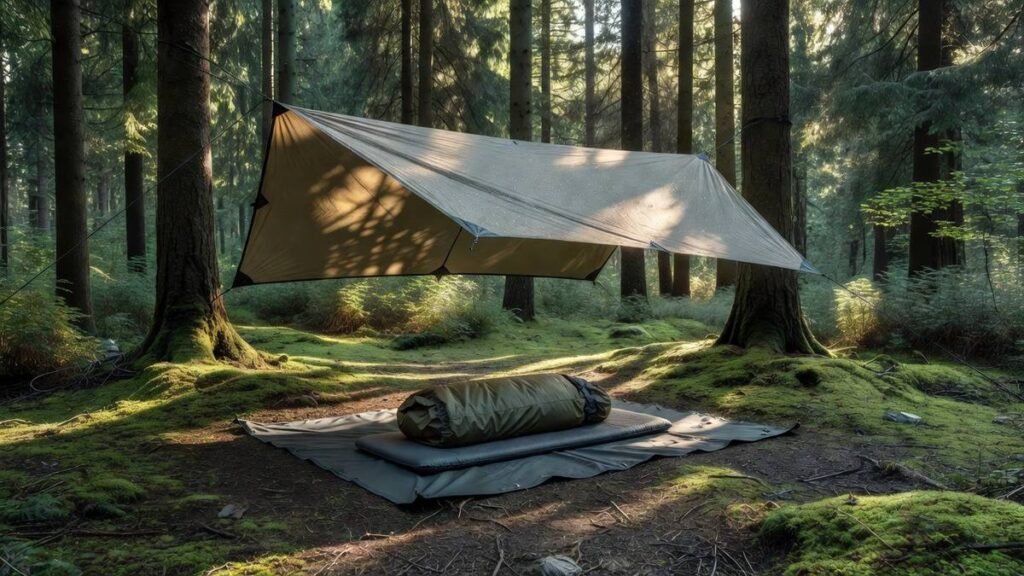
Quick answer: Yes, where camping is allowed at all. The land rules are the same with or without a tent: the US Forest Service says to check the specific forest for where camping is permitted and to follow fire restrictions and food storage. Without a tent, bring a groundsheet, a bivy or bug net, and a tarp or vehicle as a rain backup.
The woods add two things to tentless camping: insects and tree hazards. Both are manageable with planning.
This guide covers rules, site selection and the kit that replaces the tent.
Related: tent camping gear checklist, cowboy and tarp camping and where camping is allowed.
Rules First
Whether you may camp depends on the land manager, not the shelter. USFS says to check the specific forest for allowed areas, distance requirements and stay limits, and to check fire restrictions before any fire.
Site Selection in the Woods
- Arrive with daylight to survey the site, per USFS.
- Avoid areas that could flood or get muddy.
- Look up: REI winter guidance says to avoid unstable trees or limbs, and that applies year round.
- Check for ant beds, poison ivy and bees.
- Pitch on dry ground; REI notes condensation tends to form on foliage under trees, which can mean more dew on you.
The Kit That Replaces the Tent
| Need | Item |
|---|---|
| Ground damp and abrasion | Groundsheet under the pad, per Marmot footprint guidance |
| Insects | Bivy with mesh or a head net |
| Rain | Tarp pitched above, or a vehicle |
| Lightning | A building or hard-topped vehicle; NWS says no tent or tarp protects you |
| Wildlife | Food in a locker, vehicle or approved container, per NPS |
Honest Limits
Local rules vary and some forests close areas seasonally. This is general guidance; confirm with the ranger district.
Frequently Asked Questions
Is it legal to sleep in the woods without a tent?
Where camping is allowed, yes. Check the land manager.
Do I need a permit?
Some forests and all national parks require one. Check.
What about bugs?
Use a bivy with mesh or a head net.
What if it rains?
Pitch a tarp above or retreat to a vehicle.
Where should I avoid sleeping?
Under dead limbs, in low spots, near ant beds.
Is dew worse under trees?
REI notes condensation forms on foliage, so you may get more drip.
Where does food go?
Locker, vehicle or approved container, never beside you.
Can I have a fire?
Only where restrictions allow.
What about lightning?
Shelter in a building or vehicle; no tarp helps.
Do I need a groundsheet?
Yes, for damp and abrasion.
Bottom Line
Camping in the woods without a tent is fine where camping is allowed.
Bring a groundsheet, bug protection, a rain backup and store food properly.
Sources: US Forest Service, Know Before You Go: Camping; REI, Winter Camping Basics; REI, How to Prevent Condensation in a Tent; Marmot, What Is a Tent Footprint (manufacturer guide); National Weather Service, Lightning Safety; NPS, Shenandoah Food Storage.